
Lusitania Catastrophe: Part V — Life Insurance, Contracts of Life Insurance and Problems of Probate: “Why Died First?

Lusitania, Life Insurance, and “Who Died First”
– Part V

Michael
Sean Quinn*

(*See more
below)

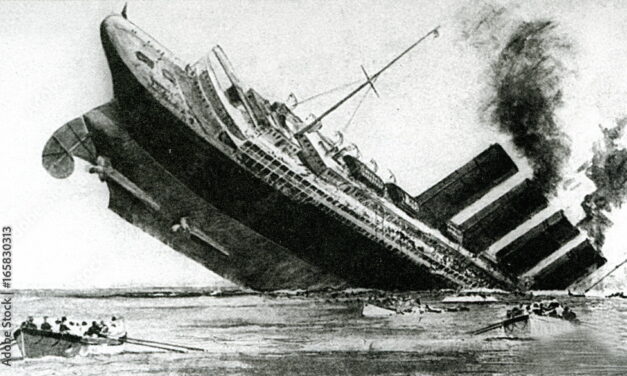
            The sinking of the Lusitania
produced a number of legal actions–a goodly amount of litigation. This series of blogs discuss some of
them, principally those related to insurance problems and several in the same
ball-park as insurance, sort of: to wit, probate related cases, more or less. (Much of the rest of the litigation was handled before the Mixed Claims Commission, and it will be discussed in a later post.) The case described here is one from the highest court in New York State, and it
involves the sinking of the Lusitania, life insurance, and a probate problem.

            The case is McGowin v. Menken, 119 N.E. 877 (N.Y. 1917). In it a married couple,
the Tassons (“H” and “W”),  perished in
the sinking of the Lusitania. At that time, H had three life insurance policies
each to be paid to W, if living, but if not then to his executors,
administrators, or assigns. The life insurer paid the money into the court
since it was not sure what should be done under New York law.  The problem was that W’s estate said it had a
claim too.

            But under the express terms of the
policy, if survivorship cannot be proved, the payment of the policy goes to the
estate of the policyholder. The court does not say so specifically, but the
right way to do this is under contract law. Life insurance policies are
contracts. W was not a party to the contract, and H had a right under the
contract to change the beneficiary(ies) as he saw fit.  Hence the insurer had a contract duty to pay
the monies due under the contract in accordance with it, namely, to the estate
(or administrators thereof). W had no property interest in assets related to
the contract, so neither she nor her estate had any right to the proceeds.

 If there was an attorney representing the party, surely he–for then it was almost certain to be “he”–would have advised them to have a provision in the policy or in H’s will that, if it could not be determined who died first, it was to be that he should be regarded as dying first.

*************** 
For those having any interest in
this matter, one of the cases the court cited is Hildenbrandt v. Ames, 66 S.W. 128 (Tex. Civ. App.—1901, writ
refus’d), a storm case.

*************

I have been suggesting that Lusitania litigation exemplified a significant departure from established, “classical,” legal thinking.  Many observe that World War I had an enormous cultural impact and was one of the dawns of the modern age.  This case is a standard example of the then current, traditional legal thinking. 

Michael Sean Quinn, Ph.D.,
J.D., c.p.c.u. . . .

The Law Firm of Michael Sean Quinn et

Quinn and Quinn

                                 1300 West Lynn Street, Suite 208

                                             Austin,
Texas 78703

                                                 (512)
296-2594

                                            (512)
344-9466 – Fax

                                E-mail:  mquinn@msquinnlaw.com

Read More
THE SINKING OF THE R.M.S. LUSITANIA

WAR RISKS and INSURANCE LAW, Decades Later

Part IV.B

There are other insurance disputes that arose quickly, either directly or indirectly, out of the sinking of the Lusitania, and those will be discussed in separate parts. The case to be discussed here, however, was not only a life insurance case, but it arose out the Japanese attack on Pearl Harbor, December 7, 1941, so the relationship between risks of war, the nature of war, and insurance were again mixed together.

The style of this case is Pang v. Sun Life Assurance Company of Canada, 37 Haw. 208 (1945). It must be remembered that Hawaii at the times relevant here was still a territory of the United States but not yet a state.  Thus, the decision was one of the Supreme Court of the Territory of Hawai’i.[1]

In any case, the plaintiff, Gladys Ching Pang (“Pang”) sued Sun Life because it denied double-indemnity coverage for her husband’s death.  Tuck Lee Pang was an employee of the Honolulu Fire Department and was killed putting out fire at Hickam Field.

There was no dispute that Mr. Pang’s death was “a death by external, violent and accidental means” falling within the meaning of the double-indemnity provisions of his Sun Life insurance policy.  The sole question was whether his death was or was not a death “resulting from war or any act incident thereto” and so be excluded from that provision.

Sun Life paid the face amount on the policy, apparently $1000.00 but refused to pay the amount of the doubling, another $1000.00.

The trial court sided with Sun Life; the plaintiff took exception to the court’s decision and judgment, and the case went to the Supreme Court.

All relevant acts were stipulated: cause of death, Japanese attack, declaration of war by America the following day, the language of the declaration, and so forth. Hence, as the Court puts it, “the real question before the court is, ‘were we at war with Japan on December 17, 1941?’” (There was another point of error—another “exception,” to use the lingo of the jurisdiction at the time—but the court did not rule on it.[2]

The Court’s reasoning is almost entirely theoretical, or philosophical, with only a twinge of the practical, and then only in the abstract. Here is a crucial section:

Various juridical consequences may flow from the existence of a state of war between two countries. For the purpose of determining when these consequences are produced, it is important to ascertain the date of the beginning and the date of the termination of a war, and it is desirable that these dates be fixed with exactness. Different dates of beginning and termination of a war may be set for different purposes. . . .

One must also keep in mind, said the court, that there are differences recognized, not always consistently, between a “state of war” and an “act of war.” Most significantly, the latter does not always include the former, or even cause it. And it must also be kept in mind that an announcement by a government that it was going to do something that would be an act of war is not itself such an act.

Given these distinction and this logic, it seemed clear to the court that a state of war did not exist between the United States and Japan on December 7th, even after the attack began.

Another way to think about this would be to distinguish amongst various types of acts of war.  Some of them start wars; some of them, as it were, invite a war; some of them provoke the start of a war; some of them are in a different war; and some of them don’t have any consequence at all. It was clear, said the court, that the United States did not regard itself as at war with Japan until Congress declared war the next day.

According to the Court, these facts and their context differentiate Pang from Vanderbilt. In that case, a war was going on between Great Britain and Germany; the Lusitania was right in the way of it, even if it was not in the thick of it; and Alfred Vanderbilt was on the ship. The historical context in Pang was quite different. There was no war going on between Japan and the U.S., though there were other wars going on that included Japan. But Pearl Harbor and Hickam Field were not in the thick of the action or right in its way. Consequently, Vanderbilt is not precedent for anything in Pang.  (The cite for the earlier case is Vanderbilt v. Travelers’ Ins. Co., 184 N.Y.S. 54 (1920), aff’d 139 N.E. 715 (1923)

It is puzzling to me that Sun Life would have failed to settle this case.  Maybe that’s because there were a good number of other cases like it and the insurer didn’t want to take “slippery slope” type chances.  Maybe it’s because in that place and that time, there was public hostility toward people with names like “Pang,” whether there were Japanese, Chinese, or something else.

——[1] The apostrophe is right there in the word. I’m not making it up.[2] The issue was whether the trial court erred in refusing entry into evidence the fact that Sun Life changed the double indemnity provision shortly after December 7th. It inserted immediately after the word “war” the phrase “whether declared or not.” For what it’s worth, I am inclined to reject the views of both the lower and the upper court. The addition of the new phrase is evidence that Sun Life though the existing formulation was at best unclear, vague, and/or ambiguous. If so, then a coverage issue should be resolved in favor of the insured and therefore the plaintiff. I wonder if in today’s world that might not constitute empirical evidence in support of an insurer bad faith case.

Read More

Lusitania Catastrophe, Insurance Issues, and International Law –Part IV.B

THE SINKING OF THE R.M.S. LUSITANIA,

WAR RISK, and INSURANCE LAW,

Decades Later

Part IV.B

Michael Sean Quinn, Ph.D., J.D., C.P.C.U. . . .*

There are other insurance disputes that arose quickly,
either directly or indirectly, out of the sinking of the Lusitania, and those
will be discussed in separate parts. The case to be discussed here, however,
was not only a life insurance case, but it arose out of another enemy attack, namely, the Japanese attack on
Pearl Harbor, December 7, 1941, so the relationships between risks of war, the
nature of war, and insurance were again mixed together.

The style of this case is Pang v. Sun Life Assurance Company of Canada, 37 Haw. 208 (1945).
It must be remembered that Hawaii at the times relevant here was still a
territory of the United States but not yet a state.  Thus, the decision was one of the Supreme
Court of the Territory of Hawai’i.[1]

In any case, the plaintiff, Gladys Ching Pang (“Pang”)
sued Sun Life because it denied double-indemnity coverage for her husband’s
death.  Tuck Lee Pang was an employee of
the Honolulu Fire Department and was killed putting out a fire at Hickam Field.

There was no dispute that Mr. Pang’s death was “a
death by external, violent and accidental means” falling within the meaning of
the double-indemnity provisions of his Sun Life insurance policy.  The sole question was whether his death was
or was not a death “resulting from war or any act incident thereto” and so be
excluded from that provision.

Sun Life paid the face amount on the policy,
apparently $1000.00 but refused to pay the amount of the doubling, another $1000.00.

The trial court sided with Sun Life; the plaintiff
took exception to the court’s decision and judgment, and the case went to the
Supreme Court.

All relevant facts were stipulated: cause of death,
Japanese attack, declaration of war by America the following day, the language
of the declaration, and so forth. Hence, as the Court puts it, “the real
question before the court is, ‘were we [i.e., the United States and its territories] at war with Japan on December 17,
1941?’” (There was another point of error—another “exception,” to use the lingo
of the jurisdiction at the time—but the court did not rule on it.[2]

The Court’s reasoning is almost entirely theoretical, even philosophical, with only a twinge of the practical, and then only in the
abstract. Here is a crucial section:

Various juridical consequences may flow from the
existence of a state of war between two countries. For the purpose of
determining when these consequences are produced, it is important to ascertain
the date of the beginning and the date of the termination of a war, and it is
desirable that these dates be fixed with exactness. Different dates of
beginning and termination of a war may be set for different purposes. . . .

One must also keep in mind, said the court, that there
are differences recognized, not always consistently, between a “state of war”
and an “act of war.” Most significantly, the latter does not always include the
former, or even cause it. And it must also be kept in mind that an announcement
by a government that it was going to do something that would be an act of war
is not itself such an act.

Given these distinctions and this logic, it seemed
clear to the court that a state of war did not exist between the United States
and Japan on December 7th, even after the attack began.

Another way to think about this would be to
distinguish amongst various types of acts of war.  Some of them start wars; some of them, as it
were, invite a war, some of them provoke the start of a war; some of them are
in a different war; and some of them don’t have any consequence at all. It was
clear, said the court, that the United States did not regard itself as at war
with Japan until Congress declared war the next day.

According to the Court, these facts, and their context
differentiate Pang from Vanderbilt. In that case, a war was
going on between Great Britain and Germany; the Lusitania was right in the way
of it, even if it was not in the thick of it; and Alfred Vanderbilt was on the
ship. The historical context in Pang
was quite different. There was no war going on between Japan and the U.S. though there were other wars going on that included Japan. But Pearl Harbor and
Hickam Field were not in the thick of the action or right in its way. Consequently, Vanderbilt is not a precedent for
anything in Pang.  (The cite for the earlier case is Vanderbilt v. Travelers’ Ins. Co., 184
N.Y.S. 54 (1920), aff’d 139 N.E. 715 (1923)

It is puzzling to me that Sun Life would have failed
to settle this case.  Maybe that’s
because there were a good number of other cases like it, and the insurer didn’t
want to take “slippery slope” type chances. 
Maybe it’s because in that place and that time, there was public
hostility toward people with names like “Pang,” whether there were Japanese,
Chinese or something else.  

*Michael Sean Quinn, Ph.D.,
J.D., C.P.C.U. . . .

The Law Firm of Michael Sean Quinn et

Quinn and Quinn

                                 1300 West Lynn Street, Suite 208

                                             Austin,
Texas 78703

                                                 (512)
296-2594

                                            (512)
344-9466 – Fax

                                E-mail:  mquinn@msquinnlaw.com

[1]
The apostrophe is right there in the word. I’m not making it up.

[2]
The issue was whether the trial court erred in refusing entry into evidence the
fact that Sun Life changed the double indemnity provision shortly after
December 7th. It inserted immediately after the word “war” the phrase “whether
declared or not.” For what it’s worth, I am inclined to reject the views of
both the lower and the upper court. The addition of the new phrase is evidence
that Sun Life though the existing formulation was at best unclear, vague,
and/or ambiguous. If so, then a coverage issue should be resolved in favor of
the insured and therefore the plaintiff. I wonder if in today’s world that
might not constitute empirical evidence in support of an insurer bad faith
case. 

Read More

Lusitania Disaster Litigation: Insurance, War Risk Exclusion — Part IV.A

THE SINKING OF THE
R.M.S. LUSITANIA AND INSURANCE, Part IV.A

Michael Sean Quinn, Ph.D.,
J.D., C.P.C.U. . . .

The first reported case of litigation flowing
out of the Lusitania catastrophe on May 7, 1915, a hundred year ago was a simple looking case in which coverage was sought
under a life insurance policy. It may say more about the times than it does
about the role of insurance in the “small picture,” and it certainly reveals
something about the changing bases of legal argument in American courts.

The contract of insurance  in
question was a life insurance  policy issued in 1903 on the life of Alfred G. Vanderbilt (“Alfred”), the son of Cornelius,  who was drowned during and as a result of the
sinking of the ship. The suit was actually brought by Frederick W. Vanderbilt
and some others, who were apparently executors of his vast estate.  Vanderbilt
v. Travelers Insurance Company, Supreme Court, New York County, New York,
Trial Term, 112 Misc. 248, 184 N.Y.S. 54 (June 1920), affirmed by the Appellate
Division, 202 A.D. 732, 194 N.Y.S. 986 (1922) (No opinion and one judge
dissenting), that appellate court being affirmed by the New York Court of
Appeals,  235 N.Y. 514, 130 N.E. 715
(1923)(Memorandum Opinion with two judges dissenting, but Benjamin Cardozo in
the majority, though not the writer of the short memorandum opinion, as its
prose makes immediately obvious)[1]

So what do we
have?  We have a reported opinion by
trial level court, a rarity in almost all states except for New York; we have
an appellate affirmation without any opinion at all, and we have an affirmation
from the highest court in a memorandum opinion. 
(I shall refer to the dissenting opinion presently.)

Remember, this
is an ordinary life insurance dispute. 
The insured, i.e., the estate of the policyholder, demanded coverage
from the life insurer, the insurer refused to pay, i.e., denied the claim, on
the basis of the provisions in the contract of insurance, and the suit
resulted.  There was no question as to
whether was an Alfred was an insured and whether he was dead. There was no issue
as to timely notice, and there were no questions about the content of the
application for insurance or any questions based upon fraud by the insured.

There was only
one question before the court, and that pertained to whether the “war risk”
exclusion applied.  That exclusion in the
policy read this way, in pertinent part:

Nor shall this
insurance cover. . . death. . . resulting, directly or indirectly, wholly or in
part from . . . war. . . .”

Often these days, exclusions like this one often involve general issues
over whether the relevant causation was direct or indirect. Or whether a loss
was caused by a particular cause completely (wholly) or in part (i.e., whether
there was another cause involved, e.g., wind and hail or wind and flood, etc.)
These were not the issues.

The dispute rested solely upon the concept or idea of war. 
Technically, I suppose, one could say that the disputed hinged on the
meaning of the word “war.” Obviously, there was a war going on between Great
Britain and Germany. Whether there was a war going on was not in dispute. At
the same time, it was beyond dispute that the United States was not “in” this
war at that time.

The court characterized the Vanderbilt position as this:

[H]owever, execrable
may be the act of a belligerent, it is none the less, with respect to private
persons, a result of war after a formal declaration thereof, and comes within
the conditions which would excuse performance under the policy of payment of
the sum for which the decedent was injured.”

I begin by confessing that I am not sure that the Vanderbilt position
is.

Maybe it’s this: there was a war, but the attack on a civilian vessel
and the killing of non-combatants could not be part of the war, but must be
something distinct from the war, since there was international law against
doing this sort of thing to a vessel like the Lusitania, while at sea. The
Vanderbilt position would be right about the claim that there were at that time
international laws forbidding what the German U-Boat did.

Or maybe it is this. There was a war going on between Germany and Great
Britain, among others, but the United States was not a belligerent in that war;
it was not a party to the war.  Hence,
the U-Boat attack was not an act of war upon the United States and therefore
not within the war risk exclusion of the Travelers’ policy.

The court would have none of it. For the court, the policy was quite
clear: there was no coverage if death resulted from war. According to the
court, this means “a war”. . . “any war.” One can wonder, I suppose, whether an
initial “act of war” means there is a war or a state of war, and I will return
to this is Part V, but in this case, there was a war, there was an event of
war, and there was what we would now call “collateral damage” resulting from
the war. In other words, the key term in the court’s decision is
“resulting  from.”

The court went a long way out of its way to establish its view. It
cited and quoted from several classical texts on international law, including Alberico
Gentilis (1553-1608) and Sir Robert Phillmore (1810-1885), as well as several
early 19th Century cases from the United States Supreme Court,
including cases pertaining to the “Indian Wars.”

My favorite of the cites is from the opinion of Justice Marshall in Brown v. United States, 8 Cranch[2]
110, 12 U.S. 110 (1814).[3]
The trial court judge in the Vanderbilt case
observes that rules of war regarding
civilians are in a sense “nice-cities” and not really part of the definition of
“war” or the concept of war  itself. “Usage and custom,” says the
judge, “prescribing the restraints imposed for the protection of noncombatants
and third person generally is merely” [and here he picks up language from
Justice Marshall’s opinion:

a guide which the
sovereign follows or abandons at his will. The rule, like other precepts of
morality, of humanity, and even of wisdom, is addressed to the judgment of the
sovereign; and although it cannot be disregarded by him with obloquy, yet it
may be disregarded.

The deciding court of the Appellate Division did not
write an opinion and the majority of the New York Court of Appeals said
nothing new.  The ground of the
dissenters was sketched ever so briefly, however:

the word
‘war,’ in the exception of the policy [what would today be called the exclusion
in the policy], because of its association, means war in which the insured
participates as a belligerent.

I have no
idea what the phrase “because of its association” might mean, or what
significance it might have. At the same time, I am reasonably certain that this
is a way of applying what it is today often called the “Rule [or Doctrine] of
Contra Preferentem” which is the legal principle that all ambiguities in a
document should be construed unfavorably to the drafter.  The rule is also called the “Ambiguity Rule” or the “Rule Against Ambiguity.” This rule is of special importance to
insurance policies, although it applies to all contracts. The reason why this
application is of special importance in that insurers are almost always the drafters
of the insurance policies, and the vast majority of insured can use whatever
help they can get.

Perhaps a
bit of trivial history about the Vanderbilt who was drowned is appropriate. He
was the scion of Cornelius Vanderbilt—not the eldest but perhaps the most
responsible from a financial point of view. 
He was mostly a sportsman and playboy, who never really grew up, but he
was to some degree involved in financial matters.  He sat on the boards of several of his
father’s railroads, and he was involved in building the Vanderbilt Hotel in New
York City; apparently he lived in the hotel at least some of the time. He was
divorced for infidelity, and his mistress and a different girlfriend seem to
have killed themselves in different and separate occasions.There is a story
about his death.  He seems to have taken
off the life jacket he got for himself and either put it on an old woman or a
young woman holding an infant. There is no disagreement about another piece of
the story, however. Alfred had never learned how to swim—odd for an inveterate
sportsman. See Greg King and Penny Wilson, LUSITANIA: Triumph, Tragedy, and the
End of the Edwardian Age (2015), the mush better though less gossipy book Erik
Larson, DEAD WAKE: The Last Crossing of the Lusitania (2015), a best seller in
the Sprint of 2015, and, of course, there is Wikipedia.

This case does not represent a significant contribution to the changes mores of American jurisprudence following the Great War. However, a strain of it is there. The plaintiff obviously expounds an different definition of “war,” attempting to use what would now be called the “Strong Ambiguity Rule” for interpreting standardized insurance policies by means of applying international law. The effort fails, and probably rightly so, but the arguments of the plaintiff are culturally advanced.

Compensation awarded and arising out the the death of Mr. Vanderbilt will be taken up again in Part XI.A-B,  These essays concerned the Mixed Claims Commission. Part XI.A explains how the Commission worked, while Part XI.B pertains to awards resulting from Mr. Vanderbilt’s death. 

A Post Script

Vanderbilt and the Mixed Claims Commission

Part I.B

As set forth above,
Alfred Vanderbilt was drowned in the Lusitania disaster and could not recover
under his life insurance policy because of a war risk exclusion. It made no
different whatever that the policy was a so-called “life and accident” policy.
From the point of view of the insured, the cause of his death was an
accident.  He certainly did not intend
it.

After World War I
was over, Germany and America created a Mixed Claims Commission. It is
characterized more fully in Part XI.A. In Part XI, B a little bit about the
compensatory damages awarded to some members of the Vanderbilt clan is set
forth.

On March 19,
1925, the Commission denied the heirs of Mr. Vanderbilt—three sons and his
widow-any compensatory damages.  See Part
XI.A-B.

Michael Sean Quinn, Ph.D.,
J.D., C.P.C.U. . . .

The Law Firm of Michael Sean Quinn et

Quinn and Quinn

                                 1300 West Lynn Street, Suite 208

                                             Austin,
Texas 78703

                                                 (512)
296-2594

                                            (512)
344-9466 – Fax

                                E-mail:  mquinn@msquinnlaw.com


[1] For those
readers not accustomed to reading this sort of thing, “Misc” names an official
reporter of the State of New York for trial level courts; “N.Y.S.” names a
publication of Westlaw or Westlaw Next. These are the big brown books one seen
in law offices or many pictures of law offices, e.g., those on the
Internet.  The reader might wish to keep
something in mind. In most states, the “Supreme Court” is the highest court in
the state. The reverse is true in New York state. Thus, the Supreme Court
just cited first, is the trial court level; in many states and in the federal
system, this is—or might be–called the “district court” or the “county court
at law,” as some of them are called in Texas, or—as it is called elsewhere–the
“court of common pleas.” The parallel cite, “N.Y.S.” is “New York Supplement”
and it refers to opinions of the Appellate Division. The second piece in the
cite is to the Appellate Division of the Supreme Court. The initial
“A.D.” means “Appellate Division,” and it is the official report of those
courts in the State of New York. The New York Court of Appeals is the highest
court in New York state now, just as it was then. The official report is
abbreviated “N.Y.,” and it is reported in Westlaw as part of the North East
“district,” Westlaw’s name,  or “N.E.,”
now “___N.E.3d. ____,” with the volume number in the first blank space and the
page number in the second.

[2]
William Cranch (1769-1855) was a lawyer and federal judge who reported cases of
the Supreme Court of the United States during some its early years.  There were several people who did this, one
after another until “U.S.” became the official reported. Judge Cranch did it
from 1801 to 1815. He is a mildly interesting character, a real estate lawyer
and speculator for a while, a relative of Abigail Adams (and therefore by
marriage to John Adams who bailed him out at one point), a relative of John
Quincy Adams, one of the “Midnight Judge” appointments between John Adams and
Thomas Jefferson but then appointed and made Chief Judge by Jefferson himself.
He also swore in two different presidents, John Tyler, and Millard Fillmore.

[3]
There were a series of “Prize” cases decided by the U.S.Supreme Court in its
early days, and Brown was one of
them. “Prize” is a term of maritime referring to right one country to capture
the ships flying the flag of another during war time. The country that captures
a prize gets to keep it.  Often crews received
some of the money. Countries at war could appoint privateers to act for them by
means of a Letter of Marque and Reprisal. The Brown case involved the cargo of a vessel that was trapped in an
American port by the onset of the Was of 1812. The cargo at issue got stuck in
the mud, quite literally, and the issue whether it could be counted as a “prize.”
British law said “Yes,” but Marshall on behalf of the Court said “No.”

Read More

Lusitania, Litigation, and Insurance — Part IVA

THE SINKING OF THE
R.M.S. LUSITANIA AND INSURANCE, Part IV.A

Michael Sean Quinn, Ph.D.,
J.D., C.P.C.U. . . .

 The first reported lawsuit flowing
out of the Lusitania catastrophe on May 7, 1915, a hundred year ago today, was a simple looking case in which coverage was sought
under a life insurance policy. It may say more about the times than it does
about the role of insurance in the “small picture,” and it certainly reveals
something about the changing bases of legal argument in American courts.

The contract of insurance  in
question was a life insurance  policy issued in 1903 on
Alfred G. Vanderbilt (“Alfred”), the son of Cornelius,  who was drowned during and as a result of the
sinking of the ship. The suit was actually brought by Frederick W. Vanderbilt
and some others, who were apparently executors of his vast estate.  Vanderbilt
v. Travelers Insurance Company, Supreme Court, New York County, New York,
Trial Term, 112 Misc. 248, 184 N.Y.S. 54 (June 1920), affirmed by the Appellate
Division, 202 A.D. 732, 194 N.Y.S. 986 (1922) (No opinion and one judge
dissenting), that appellate court being affirmed by the New York Court of
Appeals,  235 N.Y. 514, 130 N.E. 715
(1923)(Memorandum Opinion with two judges dissenting, but Benjamin Cardozo in
the majority, though not the writer of the short memorandum opinion, as its
prose makes immediately obvious)[1]

So what do we
have?  We have a reported opinion by
trial level court, a rarity in almost all states except for New York; we have
an appellate affirmation without any opinion at all, and we have an affirmation
from the highest court in a memorandum opinion. 
(I shall refer to the dissenting opinion presently.)

Remember, this
is an ordinary life insurance dispute. 
The insured, i.e., the estate of the policyholder, demanded coverage
from the life insurer, the insurer refused to pay, i.e., denied the claim, on
the basis of the provisions in the contract of insurance, and the suit
resulted.  There was no question as to
whether was an Alfred was an insured and whether he was dead. There was no issue
as to timely notice, and there were no questions about the content of the
application for insurance or any questions based upon fraud by the insured.

There was only
one question before the court and that pertained to whether the “war risk”
exclusion applied.  That exclusion in the
policy read this way, in pertinent part:

Nor shall this
insurance cover. . . death. . . resulting, directly or indirectly, wholly or in
part from . . . war. . . .”

Often these days, exclusions like this one often involve general issues
over whether the relevant causation was direct or indirect. Or whether a loss
was caused by a particular cause completely (wholly) or in part (i.e., whether
there was another cause involved, e.g., wind and hail, or wind and flood, etc.)
There were not the issues.

The dispute rested solely upon the concept or idea of war. 
Technically, I suppose, one could say that the disputed hinged on the
meaning of the word “war.” Obviously, there was a war going on between Great
Britain and Germany. Whether there was a war going on was not in dispute. At
the same time, it was beyond dispute that the United States was not “in” this
war at that time.

The court characterized the Vanderbilt position as this:

[H]owever, execrable
may be the act of a belligerent, it is none the less, with respect to private
persons, a result of war after a formal declaration thereof, and comes within
the conditions which would excuse performance under the policy of payment of
the sum for which the decedent was injured.”

I begin by confessing that I am not sure that the Vanderbilt position
is.

Maybe it’s this: there was a war, but the attack on a civilian vessel
and the killing of non-combatants could not be part of the war, but must be
something distinct from the war, since there was international law against
doing this sort of thing to a vessel like the Lusitania, while at sea. The
Vanderbilt position would be right about the claim that there were at that time
international laws forbidding what the German U-Boat did.

Or maybe it is this. There was a war going on between Germany and Great
Britain, among others, but the United States was not a belligerent in that war;
it was not a party to the war.  Hence,
the U-Boat attack was not an act of war upon the United States and therefore
not within the war risk exclusion of the Travelers’ policy.

The court would have none of it. For the court, the policy was quite
clear: there was no coverage if death resulted from war. According to the
court, this means “a war”. . . “any war.” One can wonder, I suppose, whether an
initial “act of war” means there is a war or a state of war, and I will return
to this is Part V, but in this case, there was a war, there was an event of
war, and there was what we would now call “collateral damage” resulting from
the war. In other words, the key term in the court’s decision is
“resulting  from.”

The court went a long way out of its way to establish its view. It
cited and quoted from several classical texts on international law, including Alberico
Gentilis (1553-1608) and Sir Robert Phillmore (1810-1885), as well as several
early 19th Century cases from the United States Supreme Court,
including cases pertaining to the “Indian Wars.”

My favorite of the cites is from the opinion of Justice Marshall in Brown v. United States, 8 Cranch[2]
110, 12 U.S. 110 (1814).[3]
The trial court judge in the Vanderbilt case
observes that  rules of war regarding
civilians are in a sense “nice-ities” and not really part of the definition of
“war” or the concept of war  itself. “Usage and custom,” says the
judge, “prescribing the restraints imposed for the protection of noncombatants
and third person generally is merely” [and here he picks up language from
Justice Marshall’s opinion:

a guide which the
sovereign follows or abandons at his will. The rule, like other precepts of
morality, of humanity, and even of wisdom, is addressed to the judgment of the
sovereign; and although it cannot be disregarded by him with obloquy, yet it
may be disregarded.

The deciding court of the Appellate Division did not
write an opinion, and the majority of the New York Court of Appeals said
nothing new.  The ground of the
dissenters was sketched ever so briefly, 
however:

the word
‘war,’ in the exception of the policy [what would today be called the exclusion
in the policy], because of its association, means war in which the insured
participates as a belligerent.

I have no
idea what the phrase “because of its association” might mean, or what
significance it might have. At the same time, I am reasonably certain that this
is a way of applying what it is today often called the “Rule [or Doctrine] of
Contra Preferentem” which is the legal principle that all ambiguities in a
document should be construed unfavorably to the drafter.  The rule is also called the “Ambiguity Rule,
or the “Rule Against Ambiguity.” This rule is of special importance to
insurance policies, although it applies to all contracts. The reason why this
application is of special importance in that insurers are almost always the drafters
of the insurance policies and the vast majority of insured can use whatever
help they can get.

Perhaps a
bit of trivial history about the Vanderbilt who was drowned is appropriate. He
was the scion of Cornelius Vanderbilt—not the eldest but perhaps the most
responsible from a financial point of view. 
He was mostly a sportsman and playboy, who never really grew up, but he
was to some degree involved in financial matters.  He sat on the boards of several of his
father’s railroads, and he was involved in building the Vanderbilt Hotel in New
York City; apparently he lived in the hotel at least some of the time. He was
divorced for infidelity, and his mistress and a different girl friend seem to
have killed themselves in different and separate occasions.There is a story
about his death.  He seems to have taken
off the life jacket he got for himself and either put it on an old woman or a
young woman holding an infant. There is no disagreement about another piece of
the story, however. Alfred had never learned how to swim—odd for an inveterate
sportsman. See Greg King and Penny Wilson, LUSITANIA: Triumph, Tragedy, and the
End of the Edwardian Age (2015), the mush better though less gossipy book Erik
Larson, DEAD WAKE: The Last Crossing of the Lusitania (2015), a best seller in
the Sprint of 2015, and, of course, there is Wikipedia.

I have suggested that some of the litigation following the “Great War” was part of the progressive transformation of American legal reasoning. This case does not represent a significant contribution to the changes mores of American jurisprudence following the Great War. However, a strain of it is there. The plaintiff obviously expounds an different definition of “war,” attempting to use what would now be called the “Strong Ambiguity Rule” for interpreting standardized insurance policies by means of applying international law. The effort fails, and probably rightly so, but the arguments of the plaintiff are culturally advanced. 

Michael Sean Quinn, Ph.D.,
J.D., C.P.C.U. . . .

The Law Firm of Michael Sean Quinn et

Quinn and Quinn

                                 1300 West Lynn Street, Suite 208

                                             Austin,
Texas 78703

                                                 (512)
296-2594

                                            (512)
344-9466 – Fax

                                E-mail:  mquinn@msquinnlaw.com


[1] For those
readers not accustomed to reading this sort of thing, “Misc” names an official
reporter of the State of New York for trial level courts; “N.Y.S.” names a
publication of Westlaw or Westlaw Next. These are the big brown books one seen
in law offices or many pictures of law offices, e.g., those on the
Internet.  The reader might wish to keep
something in mind. In most states, the “Supreme Court” is the highest court in
the state. There reverse is true in New York state. Thus, the Supreme Court
just cited first, is the trial court level; in many states and in the federal
system, this is—or might be–called the “district court” or the “county court
at law,” as some of them are called in Texas, or—as it is called elsewhere–the
“court of common pleas.” The parallel cite, “N.Y.S.” is “New York Supplement”
and it refers to opinions of the Appellate Division. The second piece in the
cite is to the Appellate Division of the Supreme Court. The initial
“A.D.” means “Appellate Division,” and it is the official report of those
courts in the State of New York. The New York Court of Appeals is the highest
court in New York state now, just as it was then. The official report is
abbreviated “N.Y.,” and it is reported in Westlaw as part of the North East
“district,” Westlaw’s name,  or “N.E.,”
now “___N.E.3d. ____,” with the volume number in the first blank space and the
page number in the second.

in WestLaw as part of the North Eastern “district,” WestLaw’s
name,  or “N.E,” now “N.E.3d.”

[2]
William Cranch (1769-1855) was a lawyer and federal judge who reported cases of
the Supreme Court of the United States during some its early years.  There were several people who did this, one
after another, until “U.S.” became the official reported. Judge Cranch did it
from 1801 to 1815. He is a mildly interesting character, a real estate lawyer
and speculator for a while, a relative of Abigail Adams (and therefore by
marriage to John Adams who bailed him out at one point), a relative of John
Quincy Adams, one of the “Midnight Judge” appointments between John Adams and
Thomas Jefferson but then appointed and made Chief Judge by Jefferson himself.
He also swore in two different presidents, John Tyler and Millard Fillmore.

[3]
There were a series of “Prize” cases decided by the U.S.Supreme Court in its
early days, and Brown was one of
them. “Prize” is a term of maritime referring to right one country to capture
the ships flying the flag of another during war time. The country that captures
a prize gets to keep it.  Often crews received
some of the money. Countries at war could appoint privateers to act for them by
means of a Letter of Marque and Reprisal. The Brown case involved the cargo of a vessel that was trapped in an
American port by the onset of the Was of 1812. The cargo at issue got stuck in
the mud, quite literally, and the issue whether it could be counted as a “prize.”
British law said “Yes,” but Marshall on behalf of the Court said “No.”

Read More

Quinn Quotes

In different situations, even propositions which appear undeniable may not be true in all situations.~Michael Sean Quinn, PhD, JD, CPCU, Etc.Tweet

The books shown are NOT affiliate links.
MSQ (site) does not receive any compensation for books listed or sold.
Books are shown for the reader's convenience only.

Newsletter

Michael Sean Quinn, PhD, JD, CPCU, Etc*., is available as an expert witness in insurance disputes and other litigation matters. Contact
