AlanGreenspan, Insurance Importance, & “Stinking” Economics,

Michael Sean Quinn, Ph.D, J.D., C.P.C.U., Etc.

             Law Offices of Quinn & Quinn

             2630 Exposition Blvd #115

             Austin, Texas 78703

            (o) 512-296-2594

            (c) 512-656-0503

              mquinn@msqlaw.corn

          In early September of this year, round
about September 9, 2014,

Alan Greenspan, a former Secretary of the Treasury, gave the
keynote address at KPMG’s 2014 INSURANCE INDUSTRY CONFERENCE. He listed 9
reasons why the U.S. economy stinks.  One
of the reasons he gave was “Nobody Appreciates Insurance Enough.”

          His reasoning
was that insurance is really nothing more than saving for a rainy day, and in
our country, saving-through-insurance is a major source of saving. There have been no new actuarial
methods for that since they were  invented
in the 18th Century by a couple of Christian ministers in Scotland.

          But it is not
given enough weight by economists, and it needs to thrive so that it can invest money in the new technology. So that’s one of the reasons for the stinking.  You know the one, don’t you? That the one with uniformly record high  stock prices. 

          Premise #1. One might be
doubtful about the soundness of this being said by a paid speaker at a convention of people from
the insurance industry.  Premise #2.  Greenspan was being paid plenty to speak, and he says something that will please the crowd no
end. Conclusion of Syllogism. 
The assertions in Greenspan’s speech are subject to more than passing skepticism.

          But there may
be something just as important casting doubts. 
What he said about insurance was either misleading or false. Sound actuarial methods were begun developed in the 18th Century, and a bit before actually, but there were not extensively used
immediately. Moreover, early life insurance worked on gilt system; it was mainly connected to maritime insurance; live insurance policies were originally issued for one year terms where comprehensive actuarial methods are not needed much; reliable and compreshesive mortality tables took quite a while to develop; and even during the early days  many were suspicious of
those ideas. It looked too much like gambling. They also did not have at their disposal other kinds of facts that are needed for
sound statistical analysis, e.g., causes of death. (This is true even though the astronomer Halley read a key paper to the Royal Society on the death rate in Breslau since it did not have the problems of London and Dublin, at least partly because the record keeping was defective, even shoddy. 
Moreover, actuarial methods have developed in sophistication
tremendously in the last—Oh! Say—250, or so, years (1750-2100).

.Moreover, Greenspan appears to
address only life insurance. Property and casualty insurance is not
particularly a method of long-term savings, and many insurers lose money of the
insurance sides of their businesses and make their money elsewhere, granted that
they use some of the flow of premium dollars to finance those other services. Of course, heath insurance is a relatively recent offshoot.

Of course, insurance is crucial to the economy. Insurance is big business.  It is important that it’s products be sold. And it’s important that insurers do their work–render required services–such as the adjustment of claims, in legally, business appropriate, and ethically required ways.  The same, of course, is true for the ways in which insurers treat intermediaries; they are crucial to selling the product, after all. 

                         Resumes: www.michaelseanquinn.com

Read More

THE GOOD LAWYER – Part X. – Valuing Other Lawyers

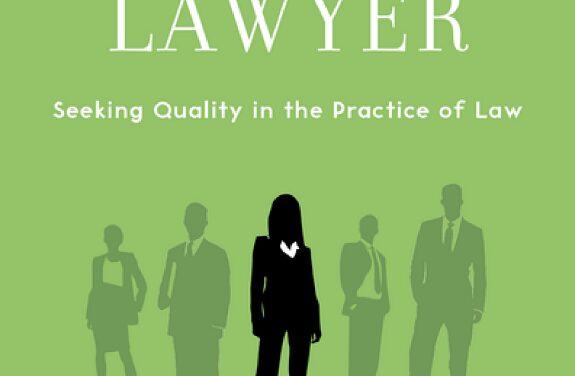
Douglas O. Linder & Nancy Levit. THE GOOD LAWYER: Seeking Quality in the Practice of Law.  Oxford University Press, 2014, with an enormous bibliography to be found in the footnotes.  My exposition, commentary and critique will be presented in eleven parts.  This is Part X. Part I should be read first. It pertained to foundations, topics, most important sources. Other parts with concern other specific matters and they will be organized by questions about, commentaries on, and therefore arguments with different chapters of the book.   

“Valuing” Other Lawyers

Here are some of the key ideas underlying Chapter #4:

Creativity is often more important than “thinking like a lawyer,” as a classically romantic view of the role of lawyers. “Quality is not measured so much as it is sensed. When you are doing quality work, you have a direction and the direction feelsright.”Feelings are important—those of the lawyer and  others. 

Now for parts of Chapter 4 itself:

Humility often carries more punch than stridency. It can be much more helpful to the client in transactional work and elsewhere.Humility does not entail weakness; it implies only civility and listening. [MSQ: It does not even imply respect, though the appearance of respect may be a good idea.] Peacemaking is part of the profession. Negotiation may be a species of peacemaking. Peacemaking, lawyer arrogance and hostility are frequently solution preventive. Negotiation requires actual conversation and not simply speech-ifying.Opposing counsel, like the ideologically different, can be not only friendly, but friends. This is good for the profession and good for the clients.Incivility among opposing counsel is to be 100% avoided.Litigation does not by its nature demand incivility.  If fact, if it is taken to be a creature of the pursuit of justice, it forbids it. The idea of a fraternal—fraternity—profession would be good for the profession and good for the clients.

For me, the ideal and spread of civility are the most important of these points.  I have very little experience with overt and expressed scorn.  People don’t yell at me. They are seldom obviously contemptuous of me, though they may feel that way, and they occasionally get me disqualified from parts of cases and rarely from whole cases, when I am acting as an expert witness.  Maybe that is because of what others have called my professorial demeanor.  I even get away with sarcasm sometimes, though what I do is light and usually not in testimony—judges don’t like it and it gets me nowhere. What I don’t know is if my experience is reflective of how the profession, for the most part, is or only how it could be.

I do not believe that lawyers viewing themselves as a fraternity of gentle”men”, i.e., “gentile persons who are also ‘gentlepersons’ and all members of the same ‘soroarofrat.’”  Publicity to the rest of the culture would be just as catastrophic now as it has been in the past.

I share the underlying idea with the authors.  I would formulate the position quite differently, however. Here goes.

Good lawyers, at least to some degree and with some degree of love, if not passion, love the law. The law—remember: something to be loved—requires that there bed a “learned” profession of lawyers.  That profession must be honored in the culture, to some extent and not soley, as well as being treated reasonable well,  for the sake of the law. In order for this to happen, lawyers must honor one another.  This honoring requires civility and restraint amongst lawyers. People are imperfect, of course, so it won’t happen all the time for anyone, including lawyers, and for some lawyers it won’t happen at all. 

For the latter, there are a number of ways to respond, i.e., deal with miscreant counsel:seek, receive, and try to use general knowledge about them through gossip,

·       

 sometimes seek, receive and then use advice from friends,

·       

obtain and contribute reports to the rumor mills,  

·       

response in kind after staying the hand,

·       

seek and special enforcement of rules usually not demanded or other lawyers, usually  not reeked upon others,

·       

seek judicial remedies, done in court (with “obscure clarity” if possible before judges,

·       

explicit reports to judges and appropriate motions, up to and including motions for sanctions,

·       

complaints to the bar,

·       

complaints to other authorities,

·       

and more.


As hard as this to imagine may be, all of it must be done with restraint and civility.  Upon a request for relief, it should be

granted whenever the client’s interests don’t demand otherwise.  There should be as little preaching, lecturing, or  moralizing as possible. No put downs. Now. Can the authors adopt this view?


If the authors have the idea that their ideal is likely to come to pass, they are wrong. Teaching  the ideal  unconditional to their

students about conformity to the ideal is a dangerous idea. Teaching the beauty of the ideal and its merits, on the other hand, is a very good idea, indeed.

There is an interesting paradox for Christians here. If the Christian society requires a legal system, and if it is to be loved, and if loving the legal system is required of its lawyers, then love amongst lawyers is also required.  See the paradox? Respect built intozealousness is not universally possible so the same is true for love. 

Read More

THE GOOD LAWYER — PART VIII — CLIENTS’ TRUE INTERESTS

Douglas O. Linder & Nancy Levit.  THE GOOD LAWYER: Seeking Quality in the Practice of Law. Oxford University Press,2014, with an enormous bibliography to be found in the footnotes. My exposition, commentary and critique will be presented in several parts. This one is on background and foundations. 

Part VIII

Part I should be read first. It pertained to foundations, topics, most important sources. Other parts with concern other specific matters and they will be organized by questions about, commentaries on, and therefore arguments with different chapters. This part is about Chapter VII, a/k/a: 

“The Good Lawyer Serves the True Interest of Clients”

The authors suggest that clients have four separate categories of interests or what they call the lawyers “goals for [the] clients.” They take them from a book by Thomas Shaffer and Robert Cochran Jr. entitled LAWYERS, CLIENTS, AND MORAL RESPONSIBILITY (2009): “client victory, client autonomy, client rectitude, and client goodness”  (p. 193).   Our authors appear to make each of these to be part of the real interests of every client, though, at one point, the authors say that a good lawyer must only choose one of these per client. (p. 193). 

I am going to ignore the one-at-a-time idea.  That cannot possibly be true, especially given their idealism. From my skeptical point of view, and I am skeptical about everything—I even think that a lawyer can be a good lawyer and pursue none of these in some lawyer-client relationships. (I also confess to being cynical about many people, though not the authors.)

Although I like Shaffer’s Christian idealism in some ways, I am not sure these categories work. 

Client Victory

What constitutes client victory? Is finishing 2nd sometimes a victory?Or 3rd?  What about losing on the judgment but cutting the damages by ½? Or ¼? Alternatively, if they are a big biz, e.g., as in theHorizon spill, the amount owed is cut by 10%, and the absolute best that could have been achieved is 11%? Let’s suppose something like this happens, and the client is not pleased but the resolution was in the client’s best interest?

Client Autonomy.  I confess I am not sure what this is.  Suppose a client has Alzheimer or one of its “relatives,” and is a danger to himself and/or others, as the courts often put it.  Is autonomy in this client’s best interest?

What about a child? What about a delinquent child?  What about a child with a drug problem? The authors say, “the choices all belong to the client.” What do we do if the client does not want to make a choice?  Is the client gripped by fear and a total lack of self-confidence? Shouldn’t I make at least some decisions for him/her? Besides, aren’t lawyers expected to make decisions for clients in litigation?

Client Rectitude

I take this to refer to the inclination to perform moral acts and avoid ones that are immoral, though it might include legal actions. If I am defending a serial killer from a death penalty, there is little,  as a lawyer, I can do to help him/her to become a moral person.  I might be able to make a contribution as a Christian, but that is not part of my being a high-quality lawyer, is it?

Are the authors saying that I, as a lawyer, have a duty to the client to do the right thing for him? What does “right” here mean? Surely, I have an obligation not to do anything illegal for him. Or morally correct? Being an “upright” person is surely a good thing, and many of us see ourselves as having a duty to  try to do that.  But, all of such acts?

Even if the client demands that we don’t do this? Or if my doing this would lead to an adverse consequence for the client? What do we do about our obligation of loyalty to the client?

Client Goodness

What is the difference between rectitude and goodness?  Maybe rectitude has to do with moral actions, whereas goodness pertains to the inner self or perhaps the soul.  Again as a Christian, Jew, or Buddhist, I may have such a duty, but simply as a lawyer, that is not part of being one of high quality, or is it?  Am I a poor lawyer unless I. . . ? What?

The authors think that lawyers have a duty to “wrestle” together with a client in trying to solve a moral problem.  The authors discuss the famous “Trolley Problem.” (p. 231), and I am inclined to lecture people on this matter since I have been thinking about it since I was a child.  I do not wrestle together with anyone about this problem. Should I?  Or is this a teaching subject?

Out of civic duty, I might represent the ISIS executioners, e.g., the one(s) that decapitated the journalists, even if done with a short dull blade.   

Suppose  I know in advance that I cannot win this case if the American forces catch him and have the right guy, but there be a defect in the government’s  handling of the case.  My duties as a lawyer are quite clear. Are any of these other duties really mine?  Idon’t think that I could do it. Does that make me a poor or bad lawyer? In fact, I think I might be just the right guy to defend his legal rights. The bombing of the federal building in Oklahoma City some years ago is a case to keep in mind.

Sometimes is it not better for the client to be very involved in the process of reputation? Consider a client who is an immoral dunce who is seeking damages in a personal injury case? Client “absence” in personal injury cases is often to the client’s advantage.  Asusual, I love and honor the idealism of the authors.  There is one point, however, upon which I disagree sharply. The authors say that “[n]othing—and we mean nothing—is as important in the lawyer-client relationship as mutual trust.” This is simplyfalse, and sometimes distrust is better than trust.

Here is an example. Not long ago, I represented the plaintiff in a case where it was crucial that my client not lie to someone.  She portrayed herself as a morally good and rectitude person.  I trusted her story—and therefore her—completely. Subsequently, counsel for the other side provided me with evidence that my client had, in fact, lied to the defendant on a crucial matter. (Opposing counsel did this very politely, very charitably, and in the spirit of trying to save my client from herself and me from my error of over-trust.) 

My trust in the client was a mistake; I had failed to investigate the client.  My client had not trusted me enough to tellme the truth. At the same time, after I discovered her distrustfulness, I continued to represent her vigorously, even after I found out the truth.  In this case, I kept her out of jail, though I did not win for her the sum of money she wanted. Thus, because I haddiscovered her feigned truthfulness I did a better job for her than I had done when I trusted her.

For me, a really interesting problem is entirely different. Granted, my duty as a lawyer is to represent the client’s true interests—that which is in the client’s interest.  Let’s reduce the complexity of the question to come by specifying that only one of the client’sinterests are at stake and that there are not two clients with slightly different interests; married couples can sometimes be like this. Now for the question: What if the client’s true interests are contrary to what the client thinks they are and says they are. Do I have a duty to represent the actual and real interests of the client? If I do, then failing to do so would not only be immoral, it would be contrary to the ethical rules of the profession, i.e., the laws governing the conduct of lawyers.  Moreover, what if the client insists on pursuing what he thinks his interests are, but he is wrong about this matter. What are the good lawyer’s duties then?  

Read More

THE GOOD LAWYER–Part VII: Lawyers & Persuasion

Douglas O. Linder and Nancy Levit. THE GOOD LAWYER: Seeking Quality in the Practice of Law. Oxford University Press, 2014, with an enormous bibliography to be found in the footnotes. My exposition, commentary and critique will be presented in several parts. This one is on background and foundations.  Part VII

Parts I and Part V should be read first. It pertained to foundations, topics, most important sources. Other parts with concern other specific matters and they will be organized by questions about, commentaries on,  and therefore  arguments with different chapters. Part II, already published, is about Chapter One of the book, and that chapter was about the good lawyer, empathy and the good lawyers’ being empathetic and being a  good lawyer.

On Being Persuasive Being persuasive is, according to the authors, at least by suggestion, is a necessary condition of being a goodlawyer.  It is not just a high correlation; it is a must.  (They don’t say this explicitly, but it’s clearly implied.) This propositionsounds like a cliche, but it really it isn’t.  This is because the authors assert that lawyers must be (and hence trained to be) persuasive in all sorts of situations lawyers face and deal with, not just in formal arguments before courts of appeals, as well as bodies like those, even though persuading at those those has been the paradigm of what law students are trained to do in law school.

An Image of a Good LawyerPresentation–Male Version: Podiums, shined shoes, dark suits, neckties which are restrained, combed hair, shaved faces or well cut beards, and so forth. An Analogous Female Version. . . . And for both: clear legal arguments, use of the deductive method of reasoning to the extent possible, explicit connections to rules—whether statutory, administrative or court precedent, with summaries of fact lilting around the rules and principles emphasized.  In other words, facts revolve around rules.  (The symbolism here is of my device, and I am attributing to the authors.) Rules are the “anchor,” and rules provide a “frame.” Legal reasoning is always legal argument. Legal argument should be rigorous. 

Judges love syllogism and so does everyone else, really, even if they don’t know it. —MSQ

This approach to persuasion is unsound, say the authors. Instead, there must be a mix. There must also be a focus on the intuitions of the listeners, a central use of persuasive stories, and the inclusion of all rhetorical products of the various types of thinking emphasized in the chapter of the book on thinking and reasoning.  The good lawyer will remember, however that calling forth the intuition—what they call “moralintuition”—is the key to all sound presentations.  (I think what the authors mean by “moralintuitions” is deep and virtually immediate perceived grasp of what is right.  In human actions, the moral intuitions of the populace are likely to be similar in better than “29 out of 30 cases.” At the same time, intuitions are made manifest by images, story anddirect appeal, not by abstract argument.

This is a beautiful chapter, and its underlying intuition is that their vision is a path to the humanization of lawyers when conceived as mechanical dolls, even creative ones.  And they are indeed correct that the great trial lawyer have this rhetorical outlook built into their very souls. (Notice I said, “great” trial lawyers, not simply “good lawyers.” Remember how the authors distinguish these two categories. Obviously I have departed from their view.)

For all of my good feelings toward it, however, I see this chapter beset by real problems:

It is not true that all good lawyers are persuasive.  There is always a back office nerd who may be brilliant, visionary, and infallibly intuitive about who will accept what, but who also stammers. His writing may be more like that of Aristotle or Aquinas than like the gifted persuasive-prose lawyer.  Most lawyers do not master both rhetorical forms, though many think they do, and this point applies to good lawyers as well as mediocre ones.What will be persuasive depends on the audience.  Appellate judges are often not taken with story-telling.  They often want, or think they want, deductive-like argumentation based on the concept, precedent and sometimes subtle distinctions.  Some appellate judges emphasize the importance of opening up judicial intuition in some ways and at some times. Many appellate judges regard storytelling by lawyers arguing cases before them with a degree of contempt. Storytelling, appeals to ordinary intuition and vivid imagery in a sophisticated business negotiation session may be appropriate in a subordinate way.  For example, if the use is to bring similar examples or history into the discussion, but their use will be subordinate to deliberative presentations and hypotheticals.Similarly–and returning to the home turf of the authors, trials—not all trials are fit places for vivid appeals to moral intuitions. Litigation that hinges upon the meanings of key terms in sophisticated contracts is much more likely to be determined by  “intellectually deliberative” methods than they will be on intuition, by inviting the morally intuitions, storytelling, and so forth.  The rational persuader, as opposed to the intuitive persuader is in much better shape in complex business cases than is the wonderful personal injury or criminal defense lawyer. Moreover, such cases are not anything like dramatic civil rights cases, the famous Scopes case (which Darrow lost in the trial court, by the way*), current abortion availability cases (whether tried to judge or jury, whether tried in Manhattan, or L.A. or East Texas**), or the dramatic, high-profile hacking and other cyber-crime cases that are sure to come. (Even story-telling, the big hack-o-rama cases will be tricky. There’s a high-tech dimension; it will have to be explained;  there may be millions of something like victims; the first layer of victims are going to be the business that got hit, e.g., Target; one of its problems is the question “What should that humongous retainer have done to prevent the attack and penetration?”; the next layer is going to be insurance companies; and so forth maybe through a lot of lawyers.  Then there are going to be all sorts of stories about the invading band of cyber marauders, and there will be the stories about those who designed and/or installed the security walls. (MSQ Question: Can there be sound litigation strategy resting principally on storytelling, where there are many, many stories to be told, nearly all at once?)In my opinion; one of the most important elements of being persuasive, aside from showing up reasonably prepared, is to avoid being boring.  This is not always easy to do. Consider a divorce case, in which one spouse it trying to increase her (or his) take given based upon the outrageous sexual conduct of the other one.  (The avoidance of being boring avoidance relatively easy in these situations: people love spice.) What abut a  case where the central issues are the hiding of vast fortunes overseas. It starts getting harder in this situation: thievery  and embezzlement always brings a little spice but lots of boring discussions occur regarding what is actually found in the bank slips, and discussions of even more boring discovery us unavoidable. People are much more interested in the identity of the hotel in which she slept with her, or he with him.) Or a case that principally involves evaluating and dividing up 1000s of acres of ranch property in west Texas, New Mexico, and Oklahoma, but where oil royalties are not involved and the children are all both loyal and cordial to each other, as well as their parents (or even when just royalties are, but there is no slant well drilling, no blow outs, no conflicts about fracking, and no environmental-ruination threats).

What is the point to all this? 

Persuasion is a complex concept with all sorts of dimensions. Not every formula (or near formula) will work in all context.  In fact, the tried and true intellectual approach works here but not there. Invocations of the vivid works over there but not right here.  And so on. 

*The Scopes case involved the loss of a very small sum of money, and it was paid by a newspaper.  The case was then won in a court of appeals, on a technicality.  So, how does intuitive persuasion together with the  story telling that goes with it fit together with  what is  known as legal argument? 

**The current case just decided in the the United States District Court for the Western District of Texas, Austin Division, Whole Woman’s Health v. David Lakey, M.D. 1:14-CV-284-LY (August 19, 2014) is worth thinking about in connection with considering how persuasion works in today’s courts. The document is entitled MEMORANDUM OPINION INCORPORATING FINDINGS OF FACT AND CONCLUSIONS OF LAW. It is easily findable on the Net. (Stay tuned for the the appellate review in the Fifth Circuit. Two Stages? One on abatement? One of merits?) (Dr. Lakey is the Commissioner of the Texas Department of State Health Services and is a party in his official capacity only. The recently indicted governor is not a party at all.)   

Read More

Lawyer Imprudence, The Lawyer as Idiot

Attorney as Addict or Worse?

This is the next chapter in the tale of Ira Mayo, a lawyer from Connecticut. He will probably become a former lawyer shortly. I published a blog on Lawyer Mayo’s history and his latest “sentence” on August 12, 2014.  Now we go on to the next one.

“Poor Ira” has had a problem regarding sex, for some time. And an acute problem it was. He could not resist seeking sex of some sort from women who were under gender-related stress (to say the least). He apparently even tried to “recruit” them into prostitution by offering them services in exchange for sex.  He has been not only previously reprimanded but suspended and also suspended from representing women in male-inflicted violence and similar cases.

This summer there was an unusual “plea” agreement. Lawyer Mayo agreed to a  complete suspension from the bar lasting from October 1st of this year until the end of January next year, and he agreed never, ever to represent any woman again in any legal matter.  

I haven’t seen the agreement or the court order, but I am left wondering whether he could represent a married couple, a family with 6 sons and an infant daughter, or a class action of 10,000 people where the class contained one (1) woman.  Never mind.  This is purely “academic curiosity.”—MSQ

Now, within a few weeks of the formation of the sentencing agreement, Lawyer Mayo went to court and told a judge that he was representing a woman. State bar Chief Disciplinary Counsel almost immediately sought his disbarment.  Mayo’s forbidden court appearance was on July 30; the bar filed its motion on August 6th, and the first hearing is on September 8th.

According to at least one newspaper, a respectable women’s group was outraged at what is regarded as the bar and the court’s mild treatment heretofore.  It seems to me, it has a point.

No doubt Lawyer Mayo will attempt one or two defenses, assuming he does turn in his card.

He might claim he did not understand the order, i.e., what he agreed to. He might say he didn’t realize that he was to begin not representing women until October 1st. This kind of defense almost never works, and it is plain silly here.He may say that he is quasi-insane and needs to be sent to a therapy/treatment center of some sort for a period of time. In relationship to that, he might suggest that he also be required to attend meetings of the Twelve Program Sex Addicts Anonymous periodically, say, every day, and then turn in attendance slips. (This is done with AA when dealing with DUI/or/DWIs all the time.Neither of these defenses seems sufficient, not to mention politically acceptable.  Maybe it could be made acceptable if all–or a substantial majority–of his previous victims consented.  Maybe several feminist organizations might also be part of that requirement.  Fairly obviously, this probably wouldn’t work.

Here is a lawyer that should be required to read and study a recently published book entitled THE GOOD LAWYER (2014) The chapters on empathy and willpower are especially important in his case.

* * * * *

If I were defending Lawyer Mayo, I would counsel him to have himself, without fanfare, castrated in advance of the September 8th hearing.  It would probably not work, of course, if for no other reason than it is tasteless and/or out of sink with the social class and/or culture appropriate to most lawyers.  Nevertheless, it is virtually certain that he will be disbarred anyway, and only a radical move stands any chance at all.

Of course, he could seek voluntary castration by order of the court, i.e., at the will of the state, with him paying the expenses, but I would be surprised if the bar would really consider agreeing to that.  Talk about inconsistency with the social class that lawyers generally think applies to them. Still, I wonder how radical feminist groups would react to this idea.—MSQ

Read More

Quinn Quotes

No proposition that is not a tautology or an analytic truth is probably always true.~Michael Sean Quinn, PhD, JD, CPCU, Etc.Tweet

The books shown are NOT affiliate links.
MSQ (site) does not receive any compensation for books listed or sold.
Books are shown for the reader's convenience only.

Newsletter

Michael Sean Quinn, PhD, JD, CPCU, Etc*., is available as an expert witness in insurance disputes and other litigation matters. Contact