Cyber Insurance and CGL Packages–Part II

This series of blog-essays contain an introduction to the Comprehensive General Liability policy used in the “real-world,” along with a type of liability insurance for the “cyber-” or “virtual world.” The latter is attached as an endorsement to the former.  This can be done with a variety of different cyber-world policies.  The one being discussed here is a malpractice policy, which appears to cover other types of liability exposures and was created for a class of cyber-design and similar professionals working on the cyber-world.  (At least some of these professionals are also called “architects,” since the platforms and other systems, network, and so forth, as designed and are, metaphorically, very much like buildings.A good thing to keep in mind is that 50+ carriers are now peddling various cyber-world policies.

Part I of this series concerned brief observations about what the dec sheet probably contained–premiums, a list of coverage parts, the identity of the agent, the names of the insureds, warnings (e.g., “Please read this policy.”), names of clients whose claims against the insured might be covered, and so forth.  It also discussed two absolutely key definitions, followed by a discussion of the insuring agreements.

Part II will discuss some of the exclusions. Most of the exclusions will be referred to very briefly, in order to give the reader a generality of what is excluded. Some of the exclusions will be discussed at more length. Those which will be mentioned only fleetingly are versions of those usually found in “real” world policies.

There are also Conditions included in the policy.  Just as in all policies there are “conditions” to be thought of, according to the insurer, as conditions precedent to the insurer having any “further” obligations at all.  Some courts have ruled that some conditions are really covenants, that is, performances the insurer has promised to do.  Classified in this way, the insurer has obligations centered on the conditions; this was not true in earlier conceptual analyses (aka legal analyses) of insurance contracts.

As previously mentioned, my comments are not intended to be authoritative. There is not enough case law to permit that.  In addition, there may be mistakes along the way. See Part I for a further description of reservations.

I will be commenting on some of the provisions of the policy.  My comments will be in typeset smaller than the statements taken from the policy, just as it was in Part I.

SOME POLICY EXCLUSIONS
No coverage where a company closely related to the named insured sues it, e.g., a subsidiary, sues the primary company, or two related companies owned both owned by the same company, sue each other and the policy covers one of the subs but not the other. (A)
No coverage where employees would have workers comp (or equivalent) coverage. (C)
No coverage when policyholder advises another on insurance (or something very insurance like) acquisition (D)
Physical dealings involving injury to ordinary “real” world tangible objects. (E)
Same for autos, boats, and airplanes. (F)
Failure to finish work on time. (G)
Unlawful discrimination. (H)
No coverage for claims generated from a contract to which the insured is a party, unless liability would have triggered anyway. (I)
No coverage for breach of contract or breach of warranties “in respect of any agreement to perform work for a specified fee.” (J) (In other words, if the insured quits a job because of non-payment of over budget fees there is not coverage.  And, of course, there are various species of this problem.)
No coverage for insolvency or bankruptcy. (K) (In other words, if the tort of the insured causes someone to become insolvent or go into bankruptcy, there is no coverage for at least part of that, e.g., the costs of the bankruptcy attributable to the injury caused by the insured, other than the other damages caused by the insured’s negligent act or omission, e.g., special legal fees for bankruptcy lawyers, and so forth.)
Injuries caused by asbestos. (M) (There is a very odd feature of this exclusion. It is applies to asbestos injuries “in hole or in part[.]”  Of course, this is nonsense.  The phrase “in hole” has meanings, but none of them fit here, and usually this sort of phrase is “in the hole,” not simply “in hole,” except for oil drilling, where “in hole” is usable.  What must be meant here is “in whole or in part; however, it is very rare for an insurance policy to contain a mistake like this one.)
No coverage for pollution or pollution caused injury or damages. (N)
No coverage for investment advice when acting as a “professional.” (O) (I confess I don’t see why this and many of the other exclusions are here, since there is no chance that any of the excluded damages will fit the insuring agreement.  Maybe some of these exclusions are designed to undermine or defeat the duty to defend.)
There is no coverage for “any claim made by any regulatory authority, or any federal state or local governmental agency.” (U)[This is a standard exclusion.  One of the reasons for it is that most of these claims are for intentional, or near intentional conduct.  Thus most of the time the doctrine of fortuity has been triggered.  I am not sure that all of this exclusion fits well into cyberworld problems.]
So far exclusions (A)-(O) & (U) have been summarily noted, setting aside (B), (L).

Coverage for “personal injury” and “advertising injury” are excluded.  “Personal injury” in this context does not mean bodily injury. It covers a group of torts, and defamation is prominent among them. (B)  It is important to recognize that, while “personal injury” itself is covered, damages arising out of “personal injury liability,” whether direct or indirect, is not. (B)[Why might these be excluded?  I suspect that this can only involve a distance between these two ideas: (1) We will pay damages for some personal injury, as defined, but we will not be liable for anything else for which you may be liable.  Consider, for example, an insured, Z, injuring A by defaming him, but A mistakenly believes that B also caused his injury.  Perhaps the insurer is refusing to pay for Z’s liability for that.]
There is no coverage for the insured’s operations as a structural “engineer.” (L)
[Structural engineering has to do with tangible objects.  That is not what this policy is about.]

There is no coverage for the insured’s liabilities to “any other [named insured] insured [under this policy],” except with respect to Privacy Injury. (P)[The phrase “Privacy Injury” is not defined.  What counts as privacy in cyberspace is not close to a settled matter; there will be legal controversy for many years.  The law review literature contains a number of disputes about this matter.  One of the best sources on this matter is Larry Lessig’s CODE 2.O. (2006). It was a redo of CODE he published in 2000, and it has been updated, but many of the ideas–at least the fundamental ones–have not changed much. Some might say the 2006 edition is outdated.  I doubt this is true.  It is a brilliant book for all sorts of reasons.  Alas, it is not easy to read.  There are plenty of newer Internet sources on this matter, but they are all too simple.  The college textbook of Richard A. Spinollo, CYBERETHICS: MORALITY AND THE LAW IN CYBERSPACE (4th ed. 2011) is newer, a far simpler beginning point, helpful and involves many ideas coming from Lessig].
There is no coverage based upon the “theft or misappropriation of trade secrets.” (Q)Remember, it is the insured that is doing the theft or the misappropriation.  These are intentional acts, so naturally there would be no coverage for them.  Liability insurance, as well as other types–first party insurance–insure against accidental risks, or risks close to accidental.  In insurance circles, it is said that insurance insures only against the fortuitous.
There is no coverage for “the infringement of patents.” (R)[Infringement of patents can be accidental, but it usually is not, so fortuity pops out again.  There is perhaps a more significant reason for this exclusion.  Dealing with patent cases is hugely expensive, both with respect to providing a defense and with respect to indemnity.  The defense expenses are also unpredictable.  Better to stay the hell away.  There is a way to deal with the situation.  Require a large retention (i.e., the insurer will pay the first).  Limit the primary policy, and then “require” that they be a tall stack of excess policies.  All the carriers would have to make sure they have substantial reinsurance.  The reader should notice that this system is getting very expensive; only rich companies could afford and rich companies are usually very large ones.  So why should they not just pick up the tab themselves?][Notice that copyright problems are not included in this exclusions.]
There is no coverage for “electrical failures, interruptions, surges, brownouts, or blackouts.”[It’s not hard to see what’s going on here.  The policy is an E & O policy for designers of cyber related “stuff.”  Electrical problems of any degree are not within that category.  Still, then can affect the quality of the policyholders work immensely.  Then again, perhaps the insureds should buy coverage for that.  It makes no more sense for professional liability carrier to insure electrical problems than it would be for  it to insure building collapses.]
There is no coverage for “intentional unauthorized access to, unauthorized use of, introduction of virus or similar malware into data or computer systems by any Insured outside their scope of duties as a partner, officer  director or employee of an Insured.  [Remember what “malware” is: it is any cyberspace transmission which injures a device for transmitting messages.  The term stands for “malicious sofware.” Viruses are a type of malware.  They are a sort of program or script, attached to something that has been transmitted, which arrives attached to emails. Worms work differently: they are not attached.  Thus, they can travel in large groups.  The probable reason they are excluded is that they intentionally send injurious transmissions and hence they are outside fortuitous risk.  Intentional misconduct is not to be insured.  It is contrary to the “essence” of insurance, even though the essence does not always apply. Consider the idea of “Personal Injury.”
Exclusion. . .V(2) shall be applied upon the final finding of guilt or fault by a jury, court or arbitrator that the act was dishonest, fraudulent, criminal, malicious or intentionally committed while knowing it was wrongful.  [This rule is extremely favorable to the insured.  It means that conduct that looks intentional cannot be classified that way by the insurer until after a final judgment.  This means that the insurer will have to defend the insured, even if the only cause of action alleged is of intentional conduct.]
Exclusions. . .V(2) shall not apply to any Insured who did not commit, acquiesce or participate in the actions which gave rise to the claim or suit.
Sometimes claims-made-policies require that the (1) event for which the claim is made against the insured, (2) the claim against the insured, and (3) the insured’s claim against the insurer must all occurt within the policy limits or during an extended period purchased by the insured. This one does not look like that. Apparently only the claim against the insured must occur within the time of policy limits or the extension, and the time limits on the insured’s claim against the insurer are restricted to a certain number of days, whenever they occur.  This may not be classified as an exclusion in the policy but part of the insuring agreement.  It is exclusionary, however, even if it not an exclusion, so I stuck it in here for good measure.

Michael Sean Quinn, Ph.D., J.D., c.p.c.u. . . .
The Law Firm of Michael Sean Quinn et
Quinn and Quinn
1300 West Lynn Street, Suite 208
Austin, Texas 78703
(512) 296-2594
(512) 344-9466 – Fax
E-mail:  mquinn@msquinnlaw.com

Read More

Legal Ethics: Excessive Fees (An Old Story)

Legal Fees and Legal History

Many say that the legal profession is going to hell in part because of excessive fees.  Some critics carry on like this is a new thing which has cropped up by as a result of the fact that the practice of law is now a business as opposed to its really having been a business all along and is now consciously and publicly thinking of itself that way.

Take heart! This is not as new problem.  Consider following quote:

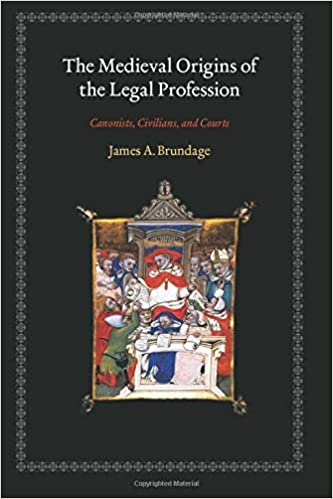
“Although authorities, including William Durand [Bishop of Mende], often thought it necessary to remind advocates not to charge their clients too much, Durand also warned that selling their services too cheaply could damage their professional standing and besmirch their reputations just a much.  Master William Doune (d.1361) likewise admonished advocates that their selling their services at bargain rates was sinful.”

James A. Brundage, THE MEDIEVAL ORIGINS OF THE LEGAL PROFESSION 330-331(2008).  The author is a professor emeritus of history and law at the University of Kansas.

Not all Professor Brundage report is flattering.  He reports that some lawyers saw themselves as noblemen and even a type of priest.  p. 476.  One wonders whether some of that attitude isn’t  alive and ever so subtly kicking still–sometimes not so subtly.

***************************************************

I have written about the matter of legal ethics and attorney fees several times in this blog.  One of them is easily found using the words “Don’t Gouge.” Or look at “Commandment Three: Don’t Gouge” 1/16/15. 

I have also written a short piece of a legal fee charged by Abraham Lincoln, an actual American president and “saint” in the Nineteenth Century. See Huge Legal Fees, Commercial Resentment and Abraham Lincoln // Lincoln’s Legal Fees: One Controversy. (September 17, 2015) 

Read More

The Unhappy Legal Culture–Part I

Evidence from “Don’t Do It”

Is there really evidence that the legal profession is in a state of decline? Evidence is weak, at best.  See Richard A. Epstein, “The Rule of Lawyers”  WALL STREET JOURNAL (May 6, 2013)  (This was an insightful article and review of  Steven Harper’s THE LAWYER BUBBLE: A PROFESSION IN CRISIS (2013). Epstein’s short article was, in part, a brief review that is better than the book.  Jacob Gershman published a response to Epstein at least on the WSJ internet the title of which was “Pricking the ‘Lawyer Bubble.” One wonders if there is not an ambiguity hidden in the title of the responsive piece. Perhaps WSJ conceived of it.  It is also worth noting that the economy is improving, the deficit is falling, and the number of lawyer jobs is increasing.

One statistic, which is often seen in the popular literature, is the claim that a typical lawyer will tell 6 out of 10 young inquirers, that they should not enter the legal profession.

The fact is that this proposition proves absolutely nothing. I usually avoid giving advice on this matter. Usually, I don’t know the person asking well enough. When I do give the advice, I consider what they have studied, how well have they done, what kind ofstamina they have, how they get along with other people, how good are they at proofreading, do they respect the judicial system, do they believe in the rule of law, and so forth. 

I also sometimes ask them if they have ever been involved in negotiating as a method of solving problems with others. If a person says “No,” then I ask why do they think that. If they have no answer I tell them not to enter the profession. They are ignorant of a crucial and intuitively fundamental point. None of these questions has anything to do with any decline in the legal profession.

The “6 ‘out of” 10” “studies,” the popular authors cite,  if any such objective studies exist, appear not to have asked meaningful questions.  There are two forms of questions: One of them probes the personality of the lawyer making the recommendation; the other concerns what the lawyers knows about the person to whom s/he is talking.  Here are some examples:

Questions to be Asked the Advisor

Why do you say this?

What branch of the law do you practice? (This question includes the general practitioner.)

How do you feel about what you do?

Have you ever felt good about the law?

Do you wish you had never entered the profession? Why not?

Would you describe yourself as a happy person? (The person asking the question should be able to look at a person and reasonably guess how they feel about the world and themselves.)

Do you see yourself as being successful at practicing law? (If the answer is “No,” ask why not. If a person says “yes,” give them a 1 to 10 test.  If they say, “I am happy as a lawyer to the degree of 10,” you know that the person being questioned is either lying or ignorant regarding simple tests. No one is perfectly happy.) 

How often do you feel really depressed?  (There are many other questions. Anyone doing the kind of “study”–as a study of those asking questions in preparation for advising on whether to go to law school–must ask a whole variety of such questions. The person constructing the study should probably seek the advice of a professional when constructing tests as the one relied on here, if—indeed—there actually was a really helpful inquiry.  Very few people are reliable estimators of their own powers of intuition when focused on themselves.

Questions Advisors Should Ask the Advisee 

What questions does the advisor ask the advisee about himself?  If no questions are asked by the advisor and the advisee is less intimate with the advisor than something close to the advisor’s spouse or one her/his children, one knows immediately that the advisor’s statements regarding the “6 out 10” rule are uninteresting, except for studying the psychology of advisors dispensing of advice.

How are/were your grades?

Do you think you get along well with other people?

Do/would other people find you easy to get along with? Or do they regard you as openly aggressive?

How articulate are you on short notice?

Do you like rigorous thinking and discussion?

What kind of family does grow up in? [I’m not sure about this question, taken just by itself, but the answer might be interesting to an advisor when taken with other answers.]

Do you like to read a lot? When you read, do you enjoy it? 

Do you like studying?  If you do, what do you like best to study?

How do you feel about competing strenuously?

Do you feel depressed from time to time?  How often?

Do you have what might be described as stamina?  In what?

Do you enjoy doing whatever you have the stamina for partly because it requires stamina?

These are all sensible and informative questions. With the exception of one potential advisor per 500 people, we do not havesound intuition about other people based on a “glance.”  (The number 500 has been dreamed up by me.  Whatever number isright, there are very few reliable estimators of their own intuitive powers.)

A Conclusion and a PromiseThis essay is about “evidence” on the basis of which critics of the legal profession-business suggest that what they regard as a huge swamp may be in a mess growing worse.  These prophets of negativity and doom love to state propositions dramatically, and thereby bash away what they think was, not is, an important cornerstone of the American republic. These dedicated creatures of preaching “You all and therefore the rest of us are bound for hell in a handbasket,” cherish the loud but do not love either objectivity or evidence.  Not only are their arguments poor, but their prose is not even close to attractive much less elegant; it’s in Dallas when the game is in Houston. They argue not only that the economics of placement is currently bleak, but that only a near economic, social, educational, and organizational revolution will rectify the deep and destructive problems.

I will present a set of Blog-essays intended to respond to some of these disaster-is-here-or-coming-soon articles, books, and blogs. Each of these essays will focus on one at a time, so there may be many parts. 

I certainly do not disagree with everything each of them asserts.  For example, it has been pointed out that student loans for law school are “back-breaking,” and I agree that it would be a good thing to somehow deal with this problem.  Who doesn’t?

Sometimes it is said that our economy and social preferences have gone awry, and the legal profession fits into a harm-causing business structure and that it needs reform across the board.  This too may be right.  I am interested only in critiques focused on the legal profession that make it look like the problems in the legal profession are distinct from general business, economic, and socio-societal problems.

Read More

Not So Sharp Texas Justice Made Sharp Statements to Public Officials

Here is a rough outline of the behavior of an elected Court of Appeals Justice in Texas. The Commission on Judicial Conduct recommended that Justice James Patrick Sharp, Jr.,” the accused,” be publicly reprimanded. There was a trial de novo before a Special Court of Review appointed by the Chief Justice of the Supreme Court of Texas. Justice Sharp and a physician testified; the empirical facts were stipulated. The account here may not be completely correct, and certainly not complete, but as stated, this is a rough outline.

The problem arose around the daughter of a woman who was not named in the opinion, but was identified as the Justice’s  “acquaintance,” as his “friend,” and as his “‘friend.'” Indeed, the Justice provided an  alternative by explaining himself by stating that he knew the child’s grandmother, a person politically influential in the relevant county, Brazoria County near Houston.  Although the Justice on the Special Court did not really mention it, any judge undertaking a private action wearing a judicial “robe” for someone with political power may be seriously questioned and contrary to the Texas Code of Judicial Ethics.

Apparently, the 15-year-old daughter of the “acquaintance”–and it has occurred to some to wonder about the actual status of the woman vis a vis Justice Sharp*–had been arrested for shoplifting. She was being held in the County’s juvenile facility over night. Her mother asked Justice Sharp to try and spring here loose that evening, which the Justice “dynamically” tried to do.  (*Is it possible that the subtitle of one of the sections is “Allowing Relationship to Influence Judicial Conduct.”  I guess not.  The Justice’s own explanation conforms to the subtitle.  At the same time, one wonders why the “friend” did not provide testimony.)

He did so on the telephone aggressively addressing some of the “juvie” attendants, the County’s District Attorney, and also a local elected District Judge.  His speech was peppered with unlikely epithets for a Justice who saw himself as exercising judicial authority, by trying to get the child released immediate, the evening before she would otherwise be eligible for it.

Here are some snippets of what he said  to this or that Brazoria public officials:

“I am a judge in [sic] the Court of Appeals. I have authority over your judges[.]”“[D]o you know who you [sic] talking to, you better release her tonight!”“Dude [the man’s nickname]. “You” have picked the wrong little girl that has friends in high places to mess with.”kid “got popped”“there’s lots of things I’ll do, and none of those things are [sic] wrong.”“Juvie folks are n[o]t just arrogant but ignorant.”“What do you want me to do? Get in my car and drive down there?”“You guys are a bunchy of back woods hillbillies that use screwed up methods in dealing with children and I promise you this, things are about to change in Brazoria County.”“…most arrogant little prick I’ve ever talked to in my life.” (Justice said to County Commissioner.)“[I]f I had been there in person that son of a bitch would have been cracked upside the head. I mean, fuck that little cocksucker.” (Justice said to District Judge.  The “f-word” is abbreviated in the opinion.”About same person: “stupid asshole”About same person: “needs… new job that never has him communicating with appellate court justices.”“Had I been there personally, it would have been ugly for him.”

The Justice deciding the case cited two other acts performed by Justice Sharp which showed that his conduct was ongoing. In one case he had physically removed property owned by a county from one office to another. The county had “ruled” that the desk be replaced. Justice Sharp knew. In another incident he was asked to produce identification at the secured entrance to a judicially occupied building, he publicly denounced the request as “silly harassment,” since the security official knew who he was.

The Justice had a psychiatrist testify, and he said that Justice Sharp suffered from Attention Deficit Disorder (ADD) and that this illness manifested common symptoms including “explosive temper,”  “inability to foresee consequences of actions,” “very short fuse,” “getting easily angered,” “easily frustrated,” “inability to let go[,]” “step back,” and/or “rethink[.]” In any case, the court found the Justice “guilty” of violating two sections of the Texas Code of Judicial Conduct. One of them forbade letting any relationshipsinfluence judicial conduct (Canon 2B). The other one was 3B(4), which requires, among other things, that a judge “shall be patient, dignified, and “not just some ‘Joe Schmo’ down the street[.]”

The court  “sentenced” [MSQ wording]—or “sanctioned”[Court’s wording] the “defendant” to “Public Reprimand.” The Court also expressed the hope that Justice Sharp would continue seeking psychological treatment.

There are those who believe that the sanction against Justice Sharp should have been more severe. One candidate for alternative sanction is that he be removed from the bench.  Another is  that the psychological treatment he is already undergoing be mandatory until a report is issued and approved by the court, that his condition has been sufficiently mitigated. Others have pointed out to the “hawks” that (1) the sanction imposed might well cost him the next election and (2) that the court’s decision is so well reasoned and restrained that it should be left where it is.

Read More

Cyber Insurance and CGL Packages: Part I

Through the Lens of a Single Policy

Introduction: The “Old Insurance World” and the “New”

My discussion of this policy will have to be divided into at least two parts  The first one will contain a Preface, a discussion of two crucial definitions, and a discussion of the Insuring Agreement. Part Two will be a discussion of a number of the Exclusions, of which there are many. Part Three will discuss a few of the Conditions and some miscellaneous clauses. Part Three will be quite brief.

Preface 

A while back, I wrote that commercial insurance for the so-called “real world,” as opposed to the “cyber world,” do not and will not apply much to the new cyber part of the “New World.” 

The Comprehensive General Liability Policy (“CGL”) is a paradigm case. One part of these policies, Coverage A, covered “bodily injury” and “property damages.” Another part, Coverage B, covered “personal injury,” a phrase contrary to ordinary English usage. It covered some acts that did not cause injuries covered in Coverage A. For the purpose of this essay, the most important provisions recently involved have been copyright infringement and invasion of privacy. Many years ago, patent disputes may have also been included in Coverage B, although at least some insurers asserted that they never intended that way.  It is gone now.  Invasion of privacy has also been covered in the past, but it has either been deleted, or it will be shortly either altogether or specifically for the cyber world.

Cases deciding the applicability of CGL provisions to the cyberworld are sparse.  In one of them, the judge decided that networks may be tangible physical property, even though they cannot be touched.  After all, said the concurring judge, it is made of  “atoms or molecules. . .and a meaningful sequence of magnetic impulses cannot float in space.”  Computer Corners, Inc. v. Fireman’s Fund Insurance Co., 46 .3d 1264 (N.M. App. 2002) (“Impaired property,” given policy language, need not be tangible physical property).  NMS Services, Inc., The Hartford, 347 Fed. Appx.  511 (4th Cir. 2003)(concurring opinion: Majority: computer damaged. Concurrence: coverage for the erasure of information from records on a physical objects is itself a physical loss. Concurrence never cited and it based on a 1983 case,)

The internal language of the CGL standard policy has recently changed substantially. Here is the new language; it is to be found within the definition of “property damage”:

“For the purposes of this insurance, electronic data is not tangible property. As used in this definition  electronic data means information, facts or programs stored as on or, created or used on, or transmitted to or from computer software, including systems and applications software, hard or floppy disks, CD-ROMS, tapes, drivers, cells, data processing devices or any other media which are used with electronically controlled equipment.”

ISO Form CG 00 01 12 07.Obviously, it no longer matters whether information, data, and so forth are tangible physical objects, they are excluded in any case.

I will be commenting on the policy as we go along.  I will try to put such substantive comments in smaller types.  That protocol does not apply yet.

There will, of course, be mixed policy limits in both first and third-party insurance, and both of these types will be so-called claims-made policies. In this case, the first party coverage is found in the “duty o defend” and the third party coverage is to be found in the “duty to indemnify

I have already discussed policies which are “double claims-made policies.”  What I mean by this is (1) that the claim against the insured must occur during the policy period and (2) that the insured’s claims to or against the insurer must also occur during the same period of time. On top of this, the policy period is expandable in one or two directions for an additional premium, and that is helpful to insureds, so long as the price is not too high. This is one of those.

Nevertheless, there is something left over from CGL policies, and probably others, e.g., professional malpractice polices for professionals such as engineers, architects, cyber designers, Directors, and Officers policies, and others–even lawyers, though probably not dentists. The leftovers are to be found among available endorsements. 

There are different kinds of endorsements. Some add substantive matters, like changing a substantive definition; some add or subtract one or more named insureds and/or items insured, e.g., cars, boats, building; some add or subtract policy limits or periods, and the list goes on. For our purposes, the type of endorsement at the question is one that adds what might be called a new policy. It turns a “standalone policy” into a “package policy.”  Our concern here is the last of these.

Our story in this essay begins with a CGL policy. To that is added an endorsement and that is the policy under consideration here. The endorsement is entitled as follows:

“Technological Professional Liability Insurance Policy  (Claims Made),”

In this case, which was issued in 2012, the word “technological” is the key to understanding what the policy is about, and that policy is the topic of this post essay.*(*I have said the following previously.  As with (virtually) all cyberworld insurance there are no–or virtually no–published opinions of the court.  There are no reported opinions about this policy–none!  Consequently, everything I say is conjecture, to some degree.  I will not be set forth and/or discussing the whole policy.  And I make mistakes, like everyone else.**)(**Notice that I have begun using small print for comments.)

This Contract of InsuranceDeclaration Pages.  One of the places to start reading, reviewing, studying, and analyzing insurance policies is with the “Declarations Page” aka “Dec Sheet(s)”  It contains a variety of bits of useful information, but often for an essay like this one, the author does not have it and cannot get it.  In this type of case, the endorsement-created-policy is often–at least in part–controlled by the dec sheet for the whole policy, and it looks like that what the dec sheet appears to say, but a lot of what’s on that sheet has been blacked out, and the Tech-Pol lists its own policy limits.  Curiously both dec sheets, if that’s the right way to talk about them, both refer to another identified document. This is not uncommon. 

Wrongful Act.  As is common in policies of this sort, and similar policies, one of the key definitions that is virtually the essence of the policy is the definition of the phrase “Wrongful Act.”  So I will begin with it:

Two Key Definitions 

“When used in this policy. . . . : the term ‘wrongful act’ means

(a) a negligent act, error or omission arising from [the] performance of ‘Technological Professional Services’ rendered to others;

(b) a network injury.”

Comments: Section(a) The phrase, “wrongful act,” is commonly used in professional malpractice insurance policies and some others.  This is a professional malpractice policy, in part, but in some ways a more general policy designed for professionals. The use of the phrase, “errors and omissions,” is also characteristic of some malpractice policies, e.g., accountants and lawyers. Here, the term “negligent” ranges overacts, errors, and omissions–all three. An intentional act that is intended to cause injury does not count as a “wrongful act.” Traditionally, it was not used in the malpractice policies of physicians.  It may strike one as unusual that the term “wrongful” would be applied exclusively to negligent performances.  Lots of other types of activities are called “wrongful” in ordinary English. But so it is. 

One feature of this definition distinguishes this policy from purely professional malpractice policies. They usually restrict coverages to injury and damage that the insured causes its own clients. That is not what this definition says. Instead, it refers to “others.” Usually, injuries directly caused by the insured others, that are not the clients, are not covered.  This difference is a big deal! (Of course,  if the damage or injury to the insured in turn causes damage or injury to another, the insurer may be liable for the damage or injury caused to the person down the line of causation.  In addition, if an uninsured person causes injury or damage to the insured and that causes the insured to injure or damage another person as the result of the insured’s own negligence, the insurer is liable. Remember: The insuring agreement cannot be understood without this key definition thoroughly in mind.)

Comments:   Section (b): There is another crucial feature of this definition, and that is section (b).  There are two different possible meanings for (b).  One goes more or less like this: “The term “wrongful act” means a negligent act, error or omission arising from the performance of Technological Professional Services rendered to a Network injury.”  I cannot see how this could make any sense.  An alternative is this: “The term ‘wrongful act’ means a negligent act, error or omission arising from the performance of Technological Professional Services to others where an injury to a relevant network is involved.”  The trouble with the second alternative is that, while it now makes grammatical sense, the policy does not really say that, and the phrase “Network Injury” is not defined in the policy or in any of the usual glossaries for terms widely and routinely used in the cyber world.  In addition, which networks and which injuries is the policy talking about?  One possibility is that it means all injuries to any network in which the insured has an insurable interest, and that is a reasonable policy.  If that is what the policy intended to say, however, it could have said that; it did not.

In order to understand the key terms within the key definition, the definition of “wrongful act,” it is necessary to understand another definition (or some parts of it “here” and other parts of it “there”), namely that of “Technological Professional Services”:

Technological Professional Services.  [This phrase means]

(a) analysis, design, programming, or integration of information, network, or computer systems;(b) processing, enter, analysis, or interpretation of data;(c) development, design, integration, or licensing of computer software;(d) resale, recommendation, marketing, installing, maintenance, and training in the use of computers or network hardware and software systems;(e) website, application or data hosting, support, maintenance or management;(f ) outsourcing to outside vendors any of the services detailed in item (b), (c), (d), (e), and (f) to be performed by individuals or businesses who are not employees or controlled or owned by the Named Insured.(g) the conduct of the Named Insured’s designated operation subject to the following classification code number(s) as scheduled above and described on form AD-150 and as applies to (a), (b), (c), (d), (e), and (f) of the “technology professional services” definitionabove.

Comments: Obviously, this list–treated as a definition–is intended to be a thorough-going catalog, of the range of actions cyber-designer, cyber-engineers, and/or their “siblings” do for their customers.  It, then, sets forth the range over what the idea of “wrongful act” ranges.  As part of the list, there is a reference to “form AD-150.”  References to documents like this are to be found in a good number of insurance policies for complex activities. They are almost never, in my experience,  part of the policies; they are not provided to the insurer in advance, and often the agent broker has no more idea about them than the insured does.  They are usually documents to be found in the “Underwriting Department,” and it is a good idea for Risk Managers of companies shopping for insurance to obtain these documents, read them, try to understand them, and if there are difficulties politely demand that they be explained.

Comments: This definition includes analogies of the kind of acts and omissions usually insured in professional malpractice policies.  There are additional features, however.  To some extent, at least, this is a result of the kind of professional services offered. For example, the following elements of the list are like that: (a), (b), (c), parts of (d)., parts of (e), and (f)?, and maybe there is more. The following elements on the list do not, at least as they appear to be, look like that: parts of  (d) (e.g., “resale,” “marketing,” “installing,” etc.), part of (e), and (f)?  Of course, it may be that each of the apparently non-covered activities–non-covered simply because of the appearance of language or unclarity–are actually professional activities in the cyber world.  It must be kept in mind, however, that an insurer may contest any of these issues. At the same time, all actual ambiguities and all actual vagaries are resolved in favor of the insured.

We now turn to the agreements as to what is covered.  (Remember: The exclusions also, in the end, determine what is covered.)

Agreement as to What’s Covered

II. Coverage – TECHNOLOGY PROFESSIONAL LIABILITY

There are two lengthy parts of the Insuring Agreement. One of them pertains to what is often called the insurer’s obligation to indemnify the other pertains to the insurer’s duty to defend the insured if accursed of a wrongful act, as defined in the policy. [The phrase “duty to indemnity can be a confusing.  The term “indemnity” means that I will pay for you eventually, but often it involves your paying and then I will pay you what you have already paid.  That is not how the duty works here.

A. INSURING AGREEMENT

The Company agrees to pay on behalf of the Insured those sums which the Insured shall become legally obligated to pay as damages arising from a Wrongful Act committed by or on behalf of the Insured subsequent to the retroactive date specified above and subject to the applicable limits specified above.

Comments:Very little needs to be said about II.A now.  The definitions have already been laid out, and the insuring agreement derives immediately from those definition.  Controversies will arise out of the definitions, not out of the insuring agreement.

Comments: From my stand point so far, the confusing point  is the idea that there is coverage not only for what the insured and its legal agents do, but also actions which are performed for the insured by someone who is not its legal agent. The injuries caused by the agents of a principal are attributable back to the principal.  This is what “vicarious liability” is all about.  There is another species of person who can act on behalf of another entity, namely independent ____________ [“somethings”].  What fills in the blank depends on the industrial context. Thus, in the area of insurance adjustment there are adjusters who are the legal agents of the insurer; adjusters who are the employees of the carrier; and independent adjusters who are not, but who are vendors and  of adjustment services.  The same is true in the sale of insurance.  There are some insurance agents who are the legal agents of the carrier and some who are independent insurance agents.  The word “behalf of” does not make make that distinction.  As a consequence, this policy insures the insured for all actions of an independent ____________, so long as there is any way the insured might be held responsible for those mistakes . This could happen.  Insured orders an independent X to do a.  X does b or ~a instead.  X’s actions are outside the scope of the insured’s instructions.  Nevertheless, it gave X orders.

B. CLAIMS MADE CLAUSE 

This does not need to be discussed further.  This policy is a “double claims made policy.”

III. Coverage – Defense, Settlement, Supplementary Payments

As respects such insurance as is afforded by the other terms of this policy, the Company [the insurer] shall:

A. defend in his name and behalf any suit against the Insured alleging damages from, or connected with Wrongful Acts, even if such suit is groundless, false or fraudulent, but the Company shall have the right to make such Investigation and negotiation of any claim or suit as may be deemed expedient by the Company;

(Comments: There are a whole range of problems in III.A, but with one exception they are familiar from “real world” insurance.  )

B. reimburse the Insured for all reasonable expenses, other than loss of earnings, incurred at the Company’s request, except amounts paid in settlement of any legal liability insured under II. COVERAGE – TECHNOLOGY PROFESSIONAL LIABILITY, which liability shall be governed by the limit of liability stated in the Declarations.

(Comments: The wording implies that the insurer will pay legal expenses as the case develops and will be in charge of defending.  This means that it will price defense counsel.  The policy also implies that if the insured wants it, it must buy a separate policy for business income loss, aka business interruption loss.)

The Company shall not be obligated to pay any claim, judgement or expenses nor defend any suit, or claim on or after the applicable limits of liability have been exhausted by payment of judgments or settlements, expenses or any combination thereof.

(Comment: The cost of legal fees reduces policy limits.)

This concludes Part I of the essay on the Admiral policy.  Part II will mainly concern exclusions.

Read More

Quinn Quotes

Truth is not a relative (or relativistic) concept. Factual propositions are true; they are false; they are too vague to have a true value, or their true value has not been determined. We don’t know, or we do not know yet, is a permissible answer to a question, so long as it is true. It is not always the case that false propositions must be apparently false. Sometimes a false proposition can look true. And vice versa. ~Michael Sean Quinn, PhD, JD, CPCU, Etc.Tweet

The books shown are NOT affiliate links.
MSQ (site) does not receive any compensation for books listed or sold.
Books are shown for the reader's convenience only.

Newsletter

Michael Sean Quinn, PhD, JD, CPCU, Etc*., is available as an expert witness in insurance disputes and other litigation matters. Contact