“Look for Coverage”– A Fundamental Principle of Adjustment

Michael
Sean Quinn, Ph.D, J.D., Etc.

2630
Exposition Blvd  #115

Austin,
Texas 78703

(o)
512-296-2594

(c)
512-656-0503

mquinn@msqlaw.com

I have asserted repeatedly for many years, and when necessary, given arguments for the axiom

Look for Coverage (“the Axiom”).  

Various publication on this topic are linked to my WebPage, and it has been included in several CLE lectures.

I have experienced only one insurance adjustment person–a former insurance commissioner who had not been involved in adjustment processes for many years and who never really studied them.  I met him because he was hired for the sole purpose of opposing my views in litigation about coverage.  Of course, I have heard about adjusters who try like the devil to avoid answering questions about the Axiom, but they invariably give in.  Not even the Commissioner provided an argument against the fundamental position of the axiom or any argument for his position.  All he did say was it was “my brain child,” and then to infer that it did not hold the axiomatic status that I said it had.  (I’m not sure whether the Commissioner was a licensed adjuster, which I am.)

I now come to the real thesis of this blog:

The Axiom “Look for Coverage” does not so much as suggest the idea “Find Coverage.”  Rather it is about pursuing a required reasonable process for a reasonable length of time.  What is reasonable depends in part by the context, though, of course, logic and objectivity must always be employed as must the proper method for empirical research and historical research.

Obviously, the complexity and streaks of doubt about a claim help determine the requirements “rational/reasonable looking” as to both the reasonable pursuit of truth and the amount of time reasonably spent on the project.  Loss of income claims can add a lot to a schedule that involves only property damages, for example.

I think there are four types of “looking”: (1) “horizontal,” (2)”vertical,” for lack of a better term, (4) “intellectual,” and (4) “critical” or “claim redo.” Horizontal looking is the effort that must be reasonably expended to find out what else counts as a covered loss.  Vertical looking is exploring a given claim more deeply. Intellectual looking is utilizing reasonable efforts to examine the claim and see what is really being claimed. This may require discussing the claim with the insured and its representative.

Critical looking is a type of rigorous critique of the insured’s formula for his claim or reasoning in support for his claim.  The purpose of this kind of “looking” is not to help determine whether to deny, although that activity exists as well.  The purpose of critical looking is to help the insured.  It is to make sure the claim makes sense.  If the insured, in effect, claims that the roof leaks but also claims it does not particularly by implication, the claim needs correction.  If the insured is making a claim for the wooden unattached car garage but states the claim in terms of the dwelling, the claim may need to be revised. If an insured makes a claim for the destruction of his dwelling on the basis of arson, but also says he burned down the business building himself by accident, the insured needs help in reformulating his claim.  These are simple examples for illustration purposes; many degrees of complexity  needing reformulation exist.  This is particularly turn  in highly complex business claims, e.g., those with business income coverage.

What if an insurer does not do something that it needs to have been done, but someone else does it.  What should happen?  There are several scenarios; one would be that once the insurer finds out, it can either pay for the work, or it can refuse. Obviously, the first of these is the correct alternative. What if the insurer is not told for a long time about the “doing” of the needed work? If the insurer’s adjustment was seriously defective in the first place, that is, worse than a simple error, there may be some degree of bad faith. And so forth.

(Each type of looking may be required by the law that all parties to any contract owe the other party some sort of good faith built into the idea of a contract. This idea is not peculiar to insurance. Still an insurer failing to do something really important and then not doing it and/or not hiring someone to do what needs to be done, can be insurer bad faith, whether from the common law or from one or more statutes.)

Read More
A Lawyer’s Mistakes & the Challenge of Attorney Errors

Michael Sean Quinn, Ph.D, J.D.*, Etc.

1300 West Lynn Suite 208

Austin, Texas 78703

(o) 512-296-2594

(c) 512-656-0503

mquinn@msqlaw.com

(*Resumes: www.michaelseanquinn.com)

Everyone agrees that at least some mistakes are good for the person making them. They are immensely good education. They increase the likelihood that errors will not happen again.

I have made three that I vividly remember, though I’m sure there have been more, just as there have been such things for all lawyers.

M#1.  When I was in law school, I clerked for my Father, a criminal defense lawyer. I cited a case; he repeated it to the federal judge, and the U.S Attorney politely pointed out that his exegesis was wrong.  My Dad was very kind and polite, but the incident discouraged that kind of error for years and years–even up to the present day.  (Of course, there always controversial interpretations; that is inevitable.  If fact, if that does not happen, the lawyer who is “error” free is not practicing real law.

M#2. In the summer of 1980 I rode the city bus to work in Dallas. I had no money just after I got out of law school. I was reviewing a brief while riding downtown. I left the draft of my brief on the bus. It got turned over to opposing counsel by Dallas Transit.  He called me immediately, told me he had not read it (and I was then and am now telling the truth) and offered to send it back or invited me to drop by his office and pick it up. I did; we had coffee; and I have done some expert witness work for him over the years.

M#3. Again, in the early days, I did not notice that there were Requests for Admission in the file when it was transferred to me. Well more than the 30 days ran. I did not answer them, since the time had already run out, and there had been no motion, I filed a MSJ and prevailed.  That lawyer seemed to be a fine fellow, so I’ve never said anything about it. The hearing and the coffee treat afterwards, were the only time I ever actually met him.  My sense of smell, the color of his face, the slight shake in his hands, and the fact he took aspirin at coffee told me what had gone wrong for him.

(Those of you who are inclined to matters of religion seriously will be tempted to say that I was being looked after, and some might say that I was being saved from myself.)

There is a final incident that I still don’t know what to make of.  Before I joined another large law firm and while I was solo practicing, I brought a small antitrust case on behalf of my client.  I had survived summary judgment, a feat I erroneously regarded as easy and simple at the time. I mentioned the matter at a picnic, in front of the head of the antitrust department, and bragged about what-all I had done, including both ingenuity and practical achievement. He was a very officious-looking fellow and wreaked of rigidity.  Most everyone regarded him as a semi-“prick,” and internally weak. I was insulted, and ignored his demand.  I heard from his “Whatever” a month or so later, and it was again demanded that my case be deposited with Master Antitrust. I indicated sneeringly that I had settled the case for $1M, and implicitly suggested that this fellow should go and “take care of himself” in his office after he had locked the door.

The mistake here, even if there appears to be only one, was the reality of actually  two. First, I was never  invited to serve on a case in that department; I would have liked to have done that. Second, my enjoyment of my action and my responsive statement caused me so much pleasure and so little pain, that it reinforces a kind of hubris that lasted in my life far too long.  I am not even sure it has been vanquished to this day.

Now, back to the general point.  Mistakes can be very instructive. They are highly educational, and when taken by it self, learning is virtually always a very good think For one thing, it always if understood leads to improved actions. The trouble is, the mistakes  hurt yourself or others (like clients), they are not so good.  Hence, the virtues of errors, contemplated in the abstract, is a complex matter.  There are many shades of gray, and thinking about this matter deeply is not so easy.  In practice, an error which leads to or constitutes education, and is even character building, but injures a client is probably not be in one of the gray zone. The deeper and/or greater the injury, the darker the gray gets.  And, if it is serous enough,  the error  may be jet black, even if it is educational.

Deep but balanced pragmatism is the philosophical foundation for most of human life.  Rigor is not all some crack it up to be.  As a pragmatic matter, however, the use of balanced pragmatism may have to be concealed behind the appearance of rigor.

Read More

Bibliography: In-House Counsel

Richard Susskind published a book called TOMORROW’S LAWYERS (Oxford U.P.*2003). He predicted that there would be more in-house counsel in the future.  He appears to have been right as of now (10/15/14). At the same time, when he made that prediction in 2003, he had a number of nasty things to say about company Legal Departments before that time. (“They need vast improvement.”) He was wrong.  He was full of shit, to use the language of the “Street.” Which “Street”?  This blog is nothing more than a bibliography of some works showing how blurred his vision was and is. . .how one of the leading self-proclaiming narcissists of the world–finishing not far behind Ralph Lauren–should either punish himself or open his mind.  Me? I say he should just bang his head against the nearest wall. (*As for Oxford U.P., it used to me one of the leading academic publishers around. That has changed.  It has cheapened itself horribly.)

Bamberger, Kenneth A.,
Technologies of Compliance: Risk and Regulation in a Digital Age. Texas Law Review, Vol. 88, p. 669, 2010;
UC Berkeley Public Law Research Paper No. 1463727. Available at SSRN: http://ssrn.com/abstract=1463727

DeMott, Deborah A., The
Discrete Roles of General Counsel, 74 FORDHAM L. REV. 955 (2005).

Galanter, Marc S. and Henderson, William D., The
Elastic Tournament: The Second Transformation
of the Big Law Firm. Stanford Law Review, Vol. 60, 2008; Indiana Legal Studies Research Paper No. 108; Univ. of
Wisconsin Legal Studies Research Paper No. 1058.
Available at SSRN: http://ssrn.com/abstract=1104711

Lipson, Jonathan C., Who’s in the House? The
Changing Role and Nature of In-House and General
Counsel (November 1, 2011). Wisconsin Law Review, Vol. 2012, No. 2,
2012; Univ. of Wisconsin Legal Studies
Research Paper No. 1197. Available at SSRN: http://ssrn.com/abstract=2077854

Langevoort, Donald C., Getting (Too)
Comfortable: In-House Lawyers, Enterprise Risk and the Financial Crisis (November 22, 2011). Georgetown Law and
Economics Research Paper No. 11-27; Georgetown Public Law Research Paper No.
11-135. Available at SSRN: http://ssrn.com/abstract=1932398

Nelson, Robert, L., & Nielsen, Laura
B., Cops, Counsel, and Entrepreneurs: Constructing
the Role of Inside Counsel in Large Corporations, 34 L. & SOC’Y REV.
457,487 (2000).

Omari Scott Simmons, Omari S. and  Dinnage, James D.,  Innkeepers: A Unifying Theory of the In-House
Counsel Role, 41 SETON HALL L. REV. 77, 79 (2011).

Parker, Christine, Gordon, Tahlia Ruth
and Mark, Steve A., Regulating Law Firm Ethics
Management: An Empirical Assessment of an Innovation in Regulation of
the Legal Profession in New South Wales.
Journal of Law and Society, Vol. 37, Issue 3, pp. 466-500, September 2010. Available at SSRN: http://ssrn.com/abstract=1667636 or http://dx.doi.org/10.1111/j.1467-6478.2010.00515.x

Rhode, Deborah L. (2011) “What
Lawyers Lack: Leadership,” University of St. Thomas Law Journal: Vol. 9:
Iss. 2, Article 3. Available at: http://ir.stthomas.edu/ustlj/vol9/iss2/3

Schwarcz, Steven L., To Make or to Buy:
In-House Lawyering and Value Creation. Journal of
Corporation Law, Vol. 33, No. 2, 2007; Duke Law School Legal Studies
Paper No. 133. Available at SSRN: http://ssrn.com/abstract=941135

Simon, William H., Where is the ‘Quality
Movement’ in Law Practice? (April 4, 2012). Wisconsin Law Review, Forthcoming;
Stanford Public Law Working Paper No. 2034503;
Columbia Public Law Research Paper No. WP 12-303. Available at SSRN: http://ssrn.com/abstract=2034503

Wilkins, David B., Is the In-house
Counsel Going Global? Assessing the Role of Internal Counsel in Emerging
Economies, 2012 WIS. L. REV. 251.

Read More

CLE FOLLIES

Michael
Sean Quinn, Ph.D, J.D., Etc., Author

Quinn and Quinn
1300 West Lynn #208

Austin,
Texas 78703

(o)
512-296-2594

(c)
512-656-0503

mquinn@msqlaw.com

PREFACE

A virtually identical version of this blog essay is to be found on another blog site entitled Quinn’s Commentaries on Lawyers and Lawyering, to be found now in the January 3, 2014 essay.  It is reprinted here, because the set of errors arose in the context of an insurance CLE, and it begins with a somewhat lengthy, but rough if not crude, discussion of the Tilley case that may be more understandable here than there.  Since the blog “next door” is the last in a three (3) part series on CLE mistakes, a word or two will be stated here at the end of the blog regarding a general category of error.  In the “tri-series” on the other Commentaries blog, they are to be found at the end of Part I. 

BACKGROUND

Several years ago, I was asked to give a noon-day luncheon talk at a CLE on Insurance Law.  I was flattered, so I took the assignment.  The talk was to be called “Tilley’s Follies.” Tilley is short hand terminology among Texas insurance lawyers and insurance defense lawyers and some others, from time to time,  for a famous case from the Texas Supreme Court that revolutionized the normative standards and general practices of  insurance defense lawyers.  They had always provide legal representing  to “accused” insureds, their clients, as they still do. After all, that’s why they are called “defense counsel.” Before the case to be discussed, theses lawyers defending an insured might also represent the insurer when there were doubts as to whether there was coverage. Of course, the liability carriers at issue here were under under a contract with their insureds to defend them.  Obviously, this triangular relationship–insurer, insured, lawyer for both–created a conflict of interest for the lawyers.  The lawyer is helping his client, the insured, and he is working against him in favor of the insurance company. After all lawyers have a duty to advocate for their clients.

This had to stop, and in “steps” the case of Employers Casualty Company v. Tilley, 496 S.W.2d 552 (Tex 1973).  It held three propositions, two of them by implication. First, lawyers may not represent both the insurer and the insured, the latter of whom (or which) the lawyer is defending without the informed consent of the insured.  Second, it is contrary to established propositions of the law of legal ethics to do this sort of thing. And, third, liability insurers may not continence the “tri-partite” relationship having this structure. Several cases have complicated the decision, nothing really of which to speak.

Here is where my problem began. For one thing, insurance defense lawyers have a duty to their clients, the “accused insureds” to discuss the case with the insurer so that the insurer can make rational decisions regarding the defense of the insured.  (Of course, it must subordinate its interests to those of the insureds, or treat them equally at least.)  For another, the defense lawyer may not lie to the insurer for obvious reasons. (For one thing it is legally unethical, second it contravenes the insured’s contractual duty to cooperate, and the lawyer is the agent of the client–the insured, and for a third reason, it would stand in the way of the lawyer’s believe-ability and that might hurt the insured’s chances of getting a reasonable decision from the insurer. At the same time the defense lawyer need not and cannot disclose everything to the insured, e.g., that which is privileged, and the lawyer may advocate his client’s interests to the insured’s carrier and his–the lawyer’s–employer.

Not that it matters here, but virtually all states have a law like this one.  Sometimes the law is weakened with the consent of the insured.  One way this can happen is if the insurer has two adjusters involved, namely one for the defense of the insured and another for coverage matters, and these adjusters are blocked off from one another. No informed insured should consent to this.

GENERAL PREPARATION

As the reader can plainly “see,” Tilley is not filled with folly. It has been very successful in the reorganization of insurance defense; what it has achieved is justice; the rule is accepted; and it has thereby improved the bar in all sorts of ways.  (For example, it has riveted attention on conflicts of interest.)

So how could I give a luncheon lecture on this non-existence subject?  The case is very serious; the reading of it is boring;  while reading it one does not have the feeling of a system being overthrown; it is not a waste of time; it is not nutty; and it not jolly.

I asked the “Program Director” what to do. I asked what her intent was. I asked if she could give me some thoughts. Even a hint would be helpful. She said simply that I have a sense of humor and cold be entertaining so not to worry about it. I concluded that she had no idea what was meant here. I asked a couple of others on the Planning Committee, but each of them said he could not remember any discussion or even the decision.  I wondered if they might not be lying.

So I was to be entertaining. The only way I can do something in a context like this one is semantic, to look at alternative meanings.  And here is where the substantive trouble really began.  I could think of nothing more that to look for sources that contained different meanings.  And so I set off.

PARTICULAR PERFORMANCE

Critique of  the Case Itself.My first whack was to describe the case, emphasize the ways in which the consent of the insured-and-client might be procured, argue that the need for the insured’s consent could be circumvented by including a needed agreement in the contract of insurance, invoke the rule ALL INSUREDS MUST READ THEIR INSURANCE POLICIES, and go on from there. The folly would then have been not to go under, over, and around the opinion and put in its grave. In addition, I would go further and say that Tilley involved a double folly. I would argue that not only was  Tilley itself a folly–I remember saying: “felonious”–but  that if lawyers with real ingenuity had had the guts to deal with it straight-on it would be dead as a door nail soon enough. Thus, I suggested that the Bar’s omission to proceed was itself a folly.  I was very proud of this idea, since folly is not usually, as a semantic matter,  thought to include omissions.

I thought this one was clever, but it flopped.  I next turned to a fun analogy. I tried the idea that Tilley was a kind of fun, a dance at a country club, maybe, or an afternoon sitting on a veranda sipping mint juleps, when I should be at the office trying to devise ways to  talk my client into consenting to my representing the insurer as well as it.

The Seward Analogy.  In 1867 William Henry Seward, the then Secretary of State arranged the purchase of Alaska from Russia for $7m, or so.  At the time the sale was consummated, at 4:00 or so,  he had permission from nobody relevant.  The sale was confirmed almost immediately.  After some time–not terribly great, news papers began calling it “Seward’s Folly.”

This would have made a good and interesting analogy for Tilley in several ways, with some components of the insurance defense bar playing the role of the newspaper.  This is such a good story, I should have spent nearly the whole lecture on it.  To this day, I think the audience would have loved the game, and the story of Seward himself who had been governor of New York state,  who had lost the Republican nomination for president to Lincoln, served as his Secretary of State, was the most important member of the cabinet, and went on to serve other presidents. See Walter Strahr, SEWARD: LINCOLN’S INDISPENSABLE MAN (2012).

I should have stopped right there.  Too bad, I did not.(A January 2016 Supplement: The Weenend WSJ for 1/23-24/2-15 carried a review of two books about the St. Francis Dam in 1928. This very damaging even may have been partially or principally caused by William Mulholand, one of the principal engineers that and politicians of sorts who created the L.A. (And yes, the “Drive” is named after him.). In any case, the review of the two book is entitled “Mulholand’s Folly.” It looks like this is analogous to the way the term is applied to Alaska, though the results were at best much more ambiguous. If I had anticipated this I certainly would have stopped at the end of the Seward discuss.)

Analogies to Fun.I then suggested that Tilley’s folly as essentially connected to  fun.  Hi-Ho the wine and booze they  flows, so let’s join in the fun; if we do, no more folly. I tried Violetta’ famous words in the first act of Verdi’s La Traviata.  “Everything in life is folly, except for pleasure.”  Well, I said, this would make the standard view of studying follies of Tilley, since there is no pleasure at all in reading.  Its prose is C- as really good court opinions go, especially when the quality of the writings of the majority opinion is combined with the even less captivating prose in the dissent.

I had no attraction to this suggestion, however, because, although the study of the case itself is sleep pro-ducing. Thinking about the profundity and elegance of the ideas and their systematic intellectual power was exhilarating. No folly in that. Alas, the audience found this idea absurd, assuming they were not mixing together their potato chips with their tomato soup. (At that noon time anti-festival I came to hate such addresses. I acknowledge that my reaction lacked objectivity, and perhaps even truth. (I wouldn’t know.   Shame, if nothing else, has kept me away.))

So I tried using it. I even had a video for the screen cut up with English subtitles the scene in Act I. I saw immediately that this had been a bad idea, if for no other reason that contemporary culture regards many follies as containing fun, fun, fun and therefore pleasure.

More About the Fun Analogy.I had anticipated this, so I looked for variations on “It’s Fun” thesis. At least, I said to myself, it would be fun in its self. I was supposed to be entertaining, said I.

I thought about using a passage from Erasmus’s satire, IN PRAISE OF FOLLY  (1511) “Now there’s an amusing and famous. Besides, its about the mistakes of lawyers, “The audience will love it.” And then I realized that it was not about insurance defense lawyers and insurance companies; its about the legal profession in general. So I wondered about, rejected that idea, and then used it any way.  .

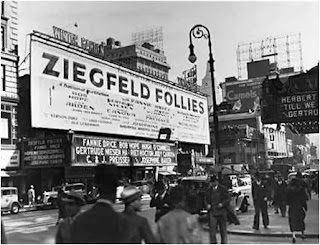
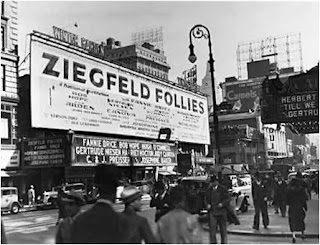
Then I thought about using photographs of famous “Fun ‘Places'”  I tried the Ziegfeld Follies: first the building and then the show itself.  The first was too introductory, suggestive of concealment by boring, and the building itself was not architecturally interesting in the slightest.  The show itself might be thought of as anti-feminist. Tilley, of course, was neither. Again, I reflected on whether to use the idea and the exhibits, but was worried about running out of time and so I used the idea anyway.  (One can see why catastrophe was looming.) I’m glad that I did not know enough about Stephen Sondheim’s FOLLIES. While it may capture some important fun parts of Ziegfeld atmospherics and perhaps that legal culture that lead up to Tilley, it would have other distracting themes.  

I played with the idea of the Follies Bergère, and did the same thing.  The building was more interesting but the inside was hardly any better that the New York venue as to the erotic and the image of women. Still, I thought that Manet’s painting of the inside made things  much better. The mirror was used to see the crowd and the woman, the bartender, looked sad.  Therefore, she could not symbolize anybody or thing involved in the case.

The Wig Analogy. Next I turned to a couple of related exhibits that picture a woman putting on a wig.  Except for the contemporary oddity of the photos, and the fact they are concealing something old with something perhaps attractive but recognizable as false, the wig scene was not really helpful, though it might be new-ish.  Still it was so quick to pass by, there would be no harm, and it would wake people up.  O thought rhyming words, like “fig,” almost rhyming words like “wiggle,” and about unrelated words like “Whig,” but nothing even so much as suggested anything. (The “Whig Union Insurance Company?)  I pondered ideas in this sector to my wits end.


At last, I gave up on fun as how to explicate the idea of folly.  I got ever more up set with the assignment I had received.  For many years, I have simply declined to follow directions, but at this point in my life, I had come to the conclusion that this attitude isn’t always such a good idea.  I didn’t know what to do, though I had faith that something could be done.

As Faith of Some Sort. So I tried that is not only procedure but substance.  I tried to think of Tilley as being a folly of faith, or that it was the destruction of an irrational faith–“It was folly [or folly-fus]–in the old order.  If I could do this I would turn that into the idea that the importance of Tilley was a matter of faith. The first of these ideas made no sense to me, and I had no evidence for the second. Consequently, I didn’t use the idea at all.  Faith in the old was obviously defective yet people had faith in it anyway.  Even after Tilley was decided many lawyers held to the old organization of the defense lawyer + insured + insurer market. The new version had a whole new approach, the right one, and so after getting used to it, faith in its future would arise in a vast majority of lawyers. (And it has.) However, the idea of progressive versus unchangeable faith sounded too religious. I was in a secular context, after all. This sort of thing–CLE’s in general–were required by a state entity, namely the Supreme Court of Texas.  This was the weakest idea yet. Even more weak that the wig episode. So again I changed course.

Book Titles. Then I began using semantically analogous language coming from different contests. I started with a book entitled WATER FOLLIES published in 2002. The title is attractive, I said to myself, but the book itself is really about how groundwater pumping destroyed the Santa Cruz River in Arizona and is sending the rest of the country into the hand basket which will take us all to hell. I immediately stopped; people were walking out. I junked this approach on the spot.  (There are lots of examples of titles like this, but I ran through the slides in 20 seconds.)

Recently I saw a fascinating book by Evgeny Morozov entitled TO SAVE EVERYTHING[,] CLICK HERE.  The subtitle of the book is “The Folly of Technological Solutionism.”  It was published in 2013. The thesis of the book, roughly speaking, is that nothing, not even the Internet, and its relatives, can cure us all of everything, and they might even do damage while we tried to make it so.  I would have used the idea as a critique of the idea that Tilley, or any other case really, can solve complex legal problems.  Of course, I’m glad I did not experience the temptation.  No doubt it would have washed me away. I never seem to learn.  See below.

The Architectural Analogy. At last I reached my third most  favorite idea: the so-called “Folly School” of architecture of the 18th Century. Here are several examples.  Their essence was to be complex, beautiful, and unfinished. Surely legal history is like that, I thought, including Tilley, perhaps above all, or–at least–most.  (If nothing else, I reassured myself, the CLE is about insurance and that includes property insurance.)

Tilley was like these I said to myself, except for the last one which comes across as wrecked as well as deliberately unfinished.  (Again, the topic or property insurance and its vicissitudes danced before my imagination.)  My opinions and its supporting arguments were complex; the whole jurisprudence was beautiful; the ideas of the case would be elaborated for centuries; and that’s how long the new approach would last. Alas, nobody lit up at the idea when it was presented. And it was obvious that nobody bought it. I was disappointed, to say the least, especially since in the first exhibit the structure appeared to be ready to fall into the sea and the last one looked like wreckage and not just intentionally incomplete.

The Poirot Analogy. This is an Agatha Christie source, coming from a novel entitled DEAD MAN’S FOLLY published in the U.S. in 1956. It has been popular for longer than a half century;  it has been serialized in a then popular magazines (US Collier’s Weekly, UK John Bull with illustrations),  translated into at least 18 languages, adapted as a film, put on the radio, run in several TV shows, including PBS’s “Masterpiece Theater in 2014, and  even a video game is named after it.  The term in the title refers to an instance of a the kind of folly now being discussed, and it plays minor roles right up to the end, when it plays a central role being the. . . . . . . . . 
The presentation was within 3 minutes of being over, so I presented by second favorite idea. A church pictured upside down.  I suggested that this is how the insurer-insured relationship could be pictured once Tilley was decided.  Again no reaction.  I see now that the idea could not be made to work.

Upsidedown-ness Analogy.  Here is an amusing and stimulating analogy, I said, as I went forward. Still, I had doubts.  Isn’t there an offensive attitude toward Christianity built into this image?  I took the chance.  Again no affect–not even some “Wow–over the sculpture work.”) This took 0.5″.

The Analogy of the Light House. I thought about showing the scene from Folly Beach in South Carolina, but rejected the idea because of the light house and its possible interpretation as to symbolism.  (“The dock was no problem, but the light house just would not work. Convey the wrong idea entirely,” I said to myself.) In this context, the abstract relationship between the light house and property insurance was not even tempting. Took 0.2″ time, since problem just flashed through my mine and I  passed the slides  by.

At last, I abandoned my efforts and showed one last slide. My time was about out already anyway. I had 1.5″.

It pictured a winding road moving up a mountain. I suggested that this picture portrayed the idea of the historical picture of the law: up a little,  aside a little and even downward either by slippage or misguided intent. (Notice that the pictured two-lane road can be driven in two directions, and it is possible to go off the road entirely and crash down several hundred feet.  When there is a crash like that you can’t get straight back up to the road.  You must avoid snakes, you may have to start over trudging along, or you may have to go-go with the flow of the stream or struggle along against it no really knowing where the river goes.)  I ended by asserting that Tilley was and is at a crucial point and was moving up.

Guess how the assembled but mostly sleepy group, that early afternoon, reacted to this ending.

So, what all might this flop tell us about CLE lecture preparation?

First, don’t try do wild stuff, even if you find it interesting, stimulating, and communicable.  Others won’t.  Don’t deviate far from the central purpose of CLEs.  That purpose is to inform those in attendance, assuming they are actually interested in the main topic, about what relevant law has been produced in the last couple of years. This is true luncheon discourse as well as serious talk.

Second, serious lectures should follow a formula.  The most important matters are the recent.  Supreme Court cases from the last couple of years.  Significant changes in statutes or administrative rules. Court of appeals cases.  The last category is the usually the most important.

Third, speakers should avoid an almost compelling urge, namely to try and develop a slew of subtle ways the cases are distinct and really contrary to each other.  Such speakers make it sound like there are real possibilities for using them to prevail when such courts conflict.  In fact, speaker-noted or created subtle distinctions are likely to fail 8 times out of 11.  It may make the speaker feel intellectually superior and in general a bigger deal in the law than those in the audience, but those trajectories of self-idoltry are to be avoided and denounced.

Fourth, Program Planners  might consider using the noonday talk to do legal ethics.  I have seen this done with digital devises and it seems to work.

Fifth, pictures and cartoons are to be limited, except during a cartoon based lecture and nothing else.  No pictures Balthus painted (1908-2001) should be used, ever!

P.S.: Here is another temptation and another possible error.  It just occurred to me this weekend, January 4, 2014.  In the lighthouse-dock group on a beach named “Folly Beach,” I entirely neglected to treat the sea and a character for creating the analogy or the symbolism for the image.  If the sea became the entirety of the relevant law, the light house would become the Tilley Principles for protecting the dock, it–the very complex dock–could be made to be the symbol for both the insureds and the insurance defense lawyers.  If I were to have tried this, it would have had to come immediately after the Steward Analogy and the only thing left would probably the highway/mountain analogy.  So the talk would have three images. Wait! Have I learned nothing?! See above.

P.S.#2: “Works of Art as Folly.” Nor am I the only Errer (i.e., one who commits errors or errs). On July 25, 2014, the House Natural Resources Committee issued a 58 pp. report calling the project for creating a memorial sculpture of Gen. Dwight Eisenhower and other soldiers, designed by a world famous designer Frank Gehry and his firm, to be placed on the Washington Mall a “Five Star Folly.”  NYT, C1 for Monday, August 4th and a picture at C4.  It’s suitably dignified, very  handsome and may be great.  Granted it’s way over budget, but the costs of works this large, complex, and large, are always a lot and government budgets for this sort of thing are almost invariably deliberately under priced at first, so that someone else can  take the blame for the gross costs.   Granted also, the critique may be a kind of political Ziegfield-folly, or easily called that, given that it is a mid-term election year.

P.S.#3. A month ago, or so, early 2015, I discovered that Stephen Sondheim created a “Broadway Musical”–music and lyrics, anyway–entitled “Follies.” Some think it among his best.  It concerns characters like those in the “Ziegfeld World.” I guess I haven’t quite learned my lesson, because I find myself wishing to have known about it and included in the presentation. (Of course, it could not have been known then, there would be talk of its being made into a movie because of the success of Into the Woods.

P.S.#4. Several days ago, mid-July 2015, I ran across a phrase I had not imagined: “sublime folly.” This phrase is used in the great 19th Century French novel, The Charterhouse of Parma by Stendhal.  It is among the thoughts of a young, naive, handsome young Italian noble man as he contemplates making love to or with a forbidden woman. Obviously, lawyer work does not involve “sublime folly,” at least not in this sense.  Then again, there is sublimity in imagining, formulating, and even giving an elegant, profound argument, even if the lawyer knows that it is not likely to win a case.  (At the same time, all competent lawyers know that one may not given even the most sublime arguments if they make losing a case more likely.)

Read More

CLE FOLLIES: TOPICAL, DESIGN, AND PRESENTATIONAL ERRORS

WHAT’S CLE ABOUT EVEN AT LUNCH

Michael Sean Quinn, Ph.D, J.D., Etc.*

Maxim: Avoid accepting invitations to give supposedly amusing lunch talks at CLE “conferences.” It’s thankless and blunder ridden. 


BACKGROUND

Several years ago, I was asked to give a noon-talk at a CLE on Insurance Law.  I was flattered, so I took the assignment.  The talk was to be called “Tilley’s Follies.” Tilley is short hand terminology among Texas insurance lawyers and insurance defense lawyers and some others, from time to time,  for a famous case from the Texas Supreme Court that revolutionized the normative standards and general practices of  insurance defense lawyers.  They had always provide legal representing  to “accused” insureds, their clients, as they still do. After all, that’s why they are called “defense counsel.” Before the case to be discussed, theses lawyers defending an insured might also represent the insurer when there were doubts as to whether there was coverage. Of course, the liability carriers at issue here were under under a contract with their insureds to defend them.  Obviously, this triangular relationship–insurer, insured, lawyer for both–created a conflict of interest for the lawyers.  The lawyer is helping his client, the insured, and he is working against him in favor of the insurance company. After all lawyers have a duty to advocate for their clients.

This had to stop, and in “steps” the case of Employers Casualty Company v. Tilley, 496 S.W.2d 552 (Tex 1973).  It held three propositions, two of them by implication. First, lawyers may not represent both the insurer and the insured, the latter of whom (or which) the lawyer is defending without the informed consent of the insured.  Second, it is contrary to established propositions of the law of legal ethics to do this sort of thing. And, third, liability insurers may not continence the “tri-partite” relationship having this structure. Several cases have complicated the decision, nothing really of which to speak.

Here is where my problem began. For one thing, insurance defense lawyers have a duty to their clients, the “accused insureds” to discuss the case with the insurer so that the insurer can make rational decisions regarding the defense of the insured.  (Of course, it must subordinate its interests to those of the insureds, or treat them equally at least.)  For another, the defense lawyer may not lie to the insurer for obvious reasons. (For one thing it is legally unethical, second it contravenes the insured’s contractual duty to cooperate, and the lawyer is the agent of the client–the insured, and for a third reason, it would stand in the way of the lawyer’s believe-ability and that might hurt the insured’s chances of getting a reasonable decision from the insurer. At the same time the defense lawyer need not and cannot disclose everything to the insured, e.g., that which is privileged, and the lawyer may advocate his client’s interests to the insured’s carrier and his–the lawyer’s–employer.

Not that it matters here, but virtually all states have a law like this one.  Sometimes the law is weakened with the consent of the insured.  One way this can happen is if the insurer has two adjusters involved, namely one for the defense of the insured and another for coverage matters, and these adjusters are blocked off from one another. No informed insured should consent to this.

GENERAL PREPARATION

As the reader can plainly “see,” Tilley is not filled with folly. It has been very successful in the reorganization of insurance defense; what it has achieved is justice; the rule is accepted; and it has thereby improved the bar in all sorts of ways.  (For example, it has riveted attention on conflicts of interest.)

So how could I give a luncheon lecture on this non-existence subject?  The case is very serious; the reading of it is boring;  while reading it one does not have the feeling of a system being overthrown; it is not a waste of time; it is not nutty; and it not jolly.

I asked the “Program Director” what to do. I asked what her intent was. I asked if she could give me some thoughts. Even a hint would be helpful. She said simply that I have a sense of humor and cold be entertaining so not to worry about it. I concluded that she had no idea what was meant here. I asked a couple of others on the Planning Committee, but each of them said he could not remember any discussion or even the decision.  I wondered if they might not be lying.

So I was to be entertaining. The only way I can do something in a context like this one is semantic, to look at alternative meanings.  And here is where the substantive trouble really began.  I could think of nothing more that to look for sources that contained different meanings.  And so I set off.

PARTICULAR PERFORMANCE

Critique of  the Case Itself.My first whack was to describe the case, emphasize the ways in which the consent of the insured-and-client might be procured, argue that the need for the insured’s consent could be circumvented by including a needed agreement in the contract of insurance, invoke the rule ALL INSUREDS MUST READ THEIR INSURANCE POLICIES, and go on from there. The folly would then have been not to go under, over, and around the opinion and put in its grave. In addition, I would go further and say that Tilley involved a double folly. I would argue that not only was  Tilley itself a folly–I remember saying: “felonious”–but  that if lawyers with real ingenuity had had the guts to deal with it straight-on it would be dead as a door nail soon enough. Thus, I suggested that the Bar’s omission to proceed was itself a folly.  I was very proud of this idea, since folly is not usually, as a semantic matter,  thought to include omissions.

I thought this one was clever, but it flopped.  I next turned to a fun analogy. I tried the idea that Tilley was a kind of fun, a dance at a country club, maybe, or an afternoon sitting on a veranda sipping mint juleps, when I should be at the office trying to devise ways to  talk my client into consenting to my representing the insurer as well as it.

The Seward Analogy.  In 1867 William Henry Seward, the then Secretary of State arranged the purchase of Alaska from Russia for $7m, or so.  At the time the sale was consummated, at 4:00 or so,  he had permission from nobody relevant.  The sale was confirmed almost immediately.  After some time–not terribly great, news papers began calling it “Seward’s Folly.”

This would have made a good and interesting analogy for Tilley in several ways, with some components of the insurance defense bar playing the role of the newspaper.  This is such a good story, I should have spent nearly the whole lecture on it.  To this day, I think the audience would have loved the game, and the story of Seward himself who had been governor of New York state,  who had lost the Republican nomination for president to Lincoln, served as his Secretary of State, was the most important member of the cabinet, and went on to serve other presidents.

I should have stopped right there.  Too bad, I did not. See Walter Strahr, SEWARD: LINCOLN’S INDISPENSABLE MAN (2012). (A January 2016 Supplement: The Weenend WSJ for 1/23-24/2-15
carried a review of two books about the St. Francis Dam in 1928. This very damaging even may have been partially or principally caused by William Mulholand, one of the principal engineers that and politicians of sorts who created the L.A. (And yes, the “Drive” is named after him.). In any case, the review of the two book is entitled “Mulholand’s Folly.” It looks like this is analogous to the way the term is applied to Alaska, though the results were at best much more ambiguous.)

Analogies to Fun.I then suggested that Tilley’s folly as essentially connected to  fun.  Hi-Ho the wine and booze they  flows, so let’s join in the fun; if we do, no more folly. I tried Violetta’ famous words in the first act of Verdi’s La Traviata.  “Everything in life is folly, except for pleasure.”  Well, I said, this would make the standard view of studying follies of Tilley, since there is no pleasure at all in reading.  Its gets a C- as really good court opinions go, especially when the quality of the writings of the majority opinion is combined with the even less captivating prose in the dissent.

I had no attraction to this suggestion, however, because, although the study of the case itself is sleep pro-ducing. Thinking about the profundity and elegance of the ideas and their systematic intellectual power was exhilarating. No folly in that. Alas, the audience found this idea absurd, assuming they were not mixing together their potato chips with their tomato soup. (At that noon time anti-festival I came to hate such addresses. I acknowledge that my reaction lacked objectivity, and perhaps even truth. (I wouldn’t know.   Shame, if nothing else, has kept me away.))

So I tried using it. I even had a video for the screen cut up with English subtitles the scene in Act I. I saw immediately that this had been a bad idea, if for no other reason that contemporary culture regards many follies as containing fun, fun, fun and therefore pleasure.

More About the Fun Analogy.I had anticipated this, so I looked for variations on “It’s Fun” thesis. At least, I said to myself, it would be fun in its self. I was supposed to be entertaining, said I.

I thought about using a passage from Erasmus’s satire, IN PRAISE OF FOLLY  (1511) “Now there’s an amusing and famous. Besides, its about the mistakes of lawyers, The audience will love it,” I said to myself.  And then I realized that it was not about insurance defense lawyers and insurance companies; its about the legal profession in general. So I wondered about, rejected that idea, and then used it any way.  .

Then I thought about using photographs of famous “Fun ‘Places'”  I tried the Ziegfeld Follies: first the building and then the show itself.  The first was too introductory, suggestive of concealment by boring, and the building itself was not architecturally interesting in the slightest.  The show itself might be thought of as anti-feminist. Tilley, of course, was neither. Again, I reflected on whether to use the idea and the exhibits, but was worried about running out of time and so I used the idea anyway.  One can see why catastrophe was looming. (Supplement 8/11/2015. I still wish I had had Cynthia and Sara Brideson’s ZIEGFELD AND HIS FOLLIES (2015) available to me. This 500+ page book outlines a history of Ziegfeld’s work and its transformation of American popular culture. Here the word “follies” and therefore “folly” does mean fun, virtually joyous, entertainment. His 1928 comedy of the West was named “Whoopee,” and was made into a movie with many of the original case, and it was a hell of a lot of fun. Maybe if there book was out, I could have shown part of it. Wait! The whole approach was a disaster. Why am I still letting it roam around in my mine.  (In any case the Bridesons’ is a marvelous book even if it contains errors noticeable to the cognoscenti, of which I am not won.  See Ethan Mordden’s review entitled “The Man Who Loved Women,” in August 8-9, 2015 Review section of WSJ.) I’m glad that I did not know enough about Stephen Sondheim’s FOLLIES. While it may capture some important fun parts of Ziegfeld atmospherics and perhaps that legal culture that lead up to Tilley, it would have other distracting themes.

I played with the idea of the Follies Bergère, and did the same thing.  The building was more interesting but the inside was hardly any better that the New York venue as to the erotic and the image of women. Still, I thought that Manet’s painting of the inside made things  much better. The mirror was used to see the crowd and the woman at the center of the painting, a bartender, looked sad.  Should not represent anybody or thing involved and that spoiled the use of the picture. 

The Wig Analogy. Next I turned to a couple of related exhibits that picture a woman putting on a wig.  Except for the contemporary oddity of the photos, and the fact they are concealing something old with something perhaps attractive but recognizable as false, the wig scene was not really helpful, though it might be new-ish.  Still it was so quick to pass by, there would be no harm, and it would wake people up.


I then gave up on fun as how to explicate the idea of folly.  I got ever more up set with the assignment I had received.  For many years, I have simply declined to follow directions, but at this point in my life, I had come to the conclusion that this attitude isn’t always such a good idea.  I didn’t know what to do, though I had faith that something could be done.

As Faith of Some Sort. So I tried that is not only procedure but substance.  I tried to think of Tilley as being a folly of faith, or that it was the destruction of an irrational faith–“It was folly [or folly-fus]–in the old order.  If I could do this I would turn that into the idea that the importance of Tilley was a matter of faith. The first of these ideas made no sense to me, and I had no evidence for the second. Consequently, I didn’t use the idea at all.  Faith in the old was obviously defective yet people had faith in it anyway.  Even after Tilley was decided many lawyers held to the old organization of the defense lawyer + insured + insurer market. The new version had a whole new approach, the right one, and so after getting used to it, faith in its future would arise in a vast majority of lawyers. (And it has.) However, the idea of progressive versus unchangeable faith sounded too religious. I was in a secular context, after all. This sort of thing–CLE’s in general–were required by a state entity, namely the Supreme Court of Texas.  This was the weakest idea yet. So again I changed course.

Book Titles. Then I began using semantically analogous language coming from different contests. I started with a book entitled WATER FOLLIES published in 2002. The title is attractive, I said to myself, but the book itself is really about how groundwater pumping destroyed the Santa Cruz River in Arizona and is sending the rest of the country into the hand basket which will take us all to hell. I immediately stopped; people were walking out. I junked this approach on the spot. (There were lots of examples of titles like this, but I ran through the tempting slides in 20 seconds.)

Recently I saw a fascinating book by Evgeny Morozov entitled TO SAVE EVERYTHING[,] CLICK HERE.  The subtitle of the book is “The Folly of Technological Solutionism.”  It was published in 2013. The thesis of the book, roughly speaking, is that nothing, not even the Internet, and its relatives, can cure us all of everything, and they might even do damage while we tried to make it so.  I would have used the idea as a critique of the idea that Tilley, or any other case really, can solve complex legal problems.  Of course, I’m glad I did not experience the temptation.  No doubt it would have washed me away. I never seem to learn.  See below.
The Architecture Analogy. At last I reached my third most  favorite idea: the so-called “Folly School” of architecture of the 18th Century. Here are several examples.  Their essence was to be complex, beautiful, and unfinished. Surely legal history is like that, I thought, including Tilley, perhaps above all, or–at least–most. 

Tilley was like these I said to myself, except for the last one which comes across as wrecked as well as deliberately unfinished. The opinion and the arguments were complex; the whole jurisprudence was beautiful; the ideas of the case would be elaborated for centuries; and that’s how long the new approach would last. Alas, nobody lit up at the idea when it was presented. And it was obvious that nobody bought it. I was disappointed, to say the least. Besides, thought I, one of these buildings looks rather like a camel, and maybe I can do something with that..

The Poirot Analogy. This is an Agatha Christie source, coming from a novel entitled DEAD MAN’S FOLLY published in the U.S. in 1956. It has been popular for longer than a half century;  it has been serialized in a then popular magazines (US Collier’s Weekly, UK John Bull with illustrations),  translated into at least 18 languages, adapted as a film, put on the radio, run in several TV shows, including PBS’s “Masterpiece Theater in 2014, and  even a video game is named after it.  The term in the title refers to an instance of a the kind of folly now being discussed, and it plays minor roles right up to the end, when it plays a central role being the. . . . . . . . .

The presentation was within 3 minutes of being over, so I presented by second favorite idea. A church pictured upside down.  I suggested that this is how the insurer-insured relationship could be pictured once Tilley was decided.  Again no reaction.  I see now that the idea could not be made to work.

Upsidedown-ness Analogy.  Here is an amusing and stimulating analogy, I said, as I went forward. I especially like the way the building tipped. Still, I had doubts.  Isn’t there an offensive attitude toward Christianity built into this image?  I took the chance.

The Analogy of the Light House. I thought about showing the scene from Folly Beach in South Carolina, but rejected the idea because of the light house.  (“The dock was no problem, but the light house just would not work. Convey the wrong idea entirely,” I said to myself.)

At last, I abandoned my efforts and showed one last slide. My time was about out already anyway. It pictured a winding road moving up a mountain. I suggested that this picture portrayed the idea of the historical picture of the law: up a little,  aside a little and even downward either by slippage or misguided intent. (Notice that the pictured two-lane road can be driven in two directions, and it is possible to go off the road entirely and crash down several hundred feet.  When there is a crash like that you can’t get straight back up to the road.  You must avoid snakes, you may have to start over trudging along, or you may have to go-go with the flow of the stream or struggle along against it no really knowing where the river goes.)  I ended by asserting that Tilley was and is at a crucial point and was moving up.

Guess how the assembled but mostly sleepy group, that early afternoon, reacted to this ending.

Now as readers, you are challenged to recognize all the mistakes. They have been recorded on the Obit
Page of an obscure paper, ad, or magazine. Even it contains interesting errors, like this blog. Good luck.

P.S.: Here is another temptation and another possible error.  It just occurred to me this weekend, January 4, 2014.  In the lighthouse-dock group on a beach named “Folly Beach,” I entirely neglected to treat the sea and a character for creating the analogy or the symbolism for the image.  If the sea became the entirety of the relevant law, the light house would become the Tilley Principles for protecting the dock, it–the very complex dock–could be made to be the symbol for both the insureds and the insurance defense lawyers.  If I were to have tried this, it would have had to come immediately after the Steward Analogy and the only thing left would probably the highway/mountain analogy.  So the talk would have three images. Wait! Have I learned nothing?! See above.

P.S.#2: “Work of Art as Folly.” Nor am I the only Errorer (i.e., one who commits errors or errs). On July 25, 2014, the House Natural Resources Committee issued a 58 pp. report calling the project for creating a memorial sculpture of Gen. Dwight Eisenhower and other soldiers, designed by a world famous designer Frank Gehry and his firm, to be placed on the Washington Mall a “Five Star Folly.”  NYT, C1 for Monday, August 4th and a picture at C4.  It’s suitably dignified, very  handsome and may be great.  Granted it’s way over budget, but the costs of works this large, complex, and large, are always a lot and government budgets for this sort of thing are almost invariably deliberately under priced at first, so that someone else can  take the blame for the gross costs.   Granted also, the critique may be a kind of political Ziegfield-folly, or easily called that, given that it is a mid-term election year.

P.S.#3. A month ago, or so, in early 2015, I discovered that Stephen Sondheim created a “Broadway Musical”–music and lyrics, anyway–entitled “Follies.” Some think it among his best.  It concerns characters like those in the “Ziegfeld World.” I guess I haven’t quite learned my lesson, because I find myself wishing to have known about it and included in the presentation. (Of course, it could not have been known then, there would be talk of its being made into a movie because of the success of Into the Woods.

I’m even thinking about writing a LinkedIn Post entitled “10 Things/Temptations to Avoid in Planning Your Next CLE Presentation [or Your First One, for that matter].” Maybe the title is too long.

P.S.#4. Several days ago, mid-July 2015, I ran across a phrase I had not imagined: “sublime folly.” This phrase is used in the great 19th Century French novel, The Charterhouse of Parma by Stendhal.  It is among the thoughts of a young, naive, handsome young Italian noble man as he contemplates making love to or with a forbidden woman. Obviously, lawyer work does not involve “sublime folly,” at least not in this sense.  Then again, there is sublimity in imagining, formulating, and even giving an elegant, profound argument, even if the lawyer knows that it is not likely to win a case.  (At the same time, all competent lawyers know that one may not given even the most sublime arguments if they make losing a case more likely.)

  Law Office of Michael Sean Quinn
Quinn and Quinn

1300 West Lynn #208

Austin, Texas 78703

(o) 512-296-2594

(c) 512-656-0503

mquinn@msqlaw.com

Read More

Quinn Quotes

Asserting a proposition one believes in a certain situation and asserting its opposition in a substantively different situation, is not necessarily inconsistent. Neither one, taken alone or together, entails advocacy.~Michael Sean Quinn, PhD, JD, CPCU, Etc.Tweet

The books shown are NOT affiliate links.
MSQ (site) does not receive any compensation for books listed or sold.
Books are shown for the reader's convenience only.

Newsletter

Michael Sean Quinn, PhD, JD, CPCU, Etc*., is available as an expert witness in insurance disputes and other litigation matters. Contact