
SOME PRINCIPLES OF LAWYER CONDUCT: FORMAL FORMULATIONS

 SOME
LECTURE  NOTES

of

Michael Sean Quinn

Quinn and   Quinn

1300 West Lynn #208

Austin, Texas 78703

mquinn@msqlaw.com

(o) 512-296-2594

(c) 512-656-0503

1.     
Lawyers (“Ls”) may not lead or permit their clients
(“Cs”) to believe that they are substantially more experienced or competent
than they are.  For that matter, L may
not let C believe that he has even a moderate amount of experience or knowledge
that he does not have.[i]  Leading a client to believe a false
proposition is misrepresentation and may be fraud.  Permitting a client to believe a false
proposition which is important is inconsistent with loyalty and
trustworthiness―as affirmative causation thereof―and therefore a breach of a
lawyer’s fiduciary duty to his client.

2.     
Ls should never represent or assert any relevant and
significant false propositions to Cs.[ii]  This proposition applies to all sorts of
representations, including:

                                           
i.           
bills and fees,

                                         
ii.           
the probable results in a case and or the possible
ranges,

                                       
iii.           
the probable worth of a case, including the probable
amounts of

recoverable
damages, and/or its possible ranges, as well as,

                                       
iv.           
even braggadocio or its opposites fall in this
category.   

The less justification
or evidence L has for making an assertion, the less likely it is that he should
make it, although certainly the more important it is that he be extremely clear
about his epistemic uncertainties, lack of evidence,  presence of hopeful guesswork, and so forth.  

3.     
L should never make, participate in making, cause to be
made, or permit to be made in his name statements about a client or former
client which he knows or believes to be false or falsifiable.

4.     
L may not represent clients with conflicting interests
without obtaining their informed consent after adequate disclosures and
discussions. 

                                           
i.           
This includes situations in which C1 is
financing all or part of L’s representation of C2.

                                         
ii.           
There are other types of conflict, of course, if L has
a business relationship with C, this may create a special conflict.  It would certainly have to be disclosed to a
judge who was to or who had approved the client-attorney relationship.  It would also have to be disclosed to any
other client involved in the same case.

5.   L should
never falsely represent to C1 that it is prudent and    reasonable to represent C2 when it is
not.  This rule is especially powerful
when L has reason to believe that this may not be a good idea.  It has even more power when L knows such to
be the case.

6.   In
litigation, a lead lawyer must rationally evaluate the value of the case.  This requires evaluating or determining to
some reasonable and appropriate degree (i) the probability of winning, (ii) the
probable size of the judgment, (iii) the probability of collecting if there is
a win, (iv) from whom there can be recovery if there is more than one
defendant, and (v) how much can be collected, both individually and
totally.  Informing C of alternative
reasonable and fact-based, if possible, hypotheses (or, points of view)
regarding these kinds of matters is also required to the extent possible, but
there must be some sort of unequivocal recommendation as to what L reasonably
believes is in the best interests of the client (considered by himself
alone)―given the client’s knowledge, economics, finances, budget, view of the
world, preferences, personal (or entity) orientation, and character,  together with the financial situations of
each of the defendants.[iii] Significantly, P-6
is linked closely to P-2.iii.

7.   The
preceding principle (P-6) applies both to actual persons and to organizations,
such as corporations and limited partnerships, which are legal persons.  It also pertains independently to each client
involved in the same dispute.

8.   If no
P-6 type evaluation is possible, L must inform the client that s/he[iv]
does not know the answer and cannot come to know it.  Why this inability is true must be reasonably
explained to C.  Obviously, if the
opposing side is concealing or refusing to produce relevant evidence, this fact
in itself can be an important premise in drawing relevant conclusions.  Often, if the opposing side is concealing
economic information, traces of this activity or diagnostic behavior can be
discerned.

9.   L should
never convince C, try to convince a client, or even suggest to C that a case
should be pursued which L believes cannot be won, is unlikely to be won, or
cannot serve the personal interests of the client.[v]  Exit by a party from given litigation is
almost always an option, as is immediate resolution by some settlement or other
means.  This rule applies with enormous
force to high-cost-to-the-client cases. 
(The rule is less forceful in contingency fee cases where L is bearing
the expenses, although it still applies, for various reasons.)  If C wants to spend—what many would call
“squander”—money on a loser case just to illustrate justice or to seek
retribution or vengeance, L should help C understand exactly what he is doing
and what the consequences of his pursuit will and will not be.  This is one of the duties of L, the wise
adviser.

10. As
enormously important as P-9 is, it is even more important that L refrain from
instituting or continuing litigation because it is in L’s interest, when it is
not in the interest of C.

11. Unnecessary
or irrelevant parties should not be sued by Ls representing Cs that are
plaintiffs or counter-plaintiffs, and if such parties have been sued, they
should be dismissed when their lack of involvement becomes clear.  Contrary conduct by L is inconsistent with
L’s duties to C, as well as his legal and professional duties.

12. And, of
course, all the probably necessary plaintiffs should be included in original
pleadings and/or amended pleadings, if possible.  Here L obligation to include X as a plaintiff
results either from X’s voluntary consent or C’s control rights over X.

13. Usually,
all probably blameworthy, responsible, and/or liable parties should be included
as parties by L representing a plaintiff. (There are exceptions, of course).

14. In
litigation, L should proceed upon all appropriate legal theories, avoid all
inappropriate ones, seek all legally appropriate and needed remedies, and avoid
seeking illegitimate or legally unjustifiable remedies. It is also not always
clear before factual discovery what the appropriate legal theories are. Here is
an example. If recovery hinges on negligence, it is inappropriate to sue for
fraud. Assuming the relevant facts are reasonably certain at the time of
pleadings.  Suing on false theories to
threaten someone seldom works. If recovery hinges on the unlawful diversion and
hence deprivation of corporate asserts, then an action should proceed on that
basis.

15. L may not
charge C unreasonable fees.  Stated fees,
at least for plaintiffs, can be unreasonable because they are unnecessary,
because they are false, because they result from overstaffing, or because they
are substantially out of kilter with the value of a case, the experience and
level of ability of the lawyer (which has been disclosed), the degree of
complexity of the case, the difficulty of the tasks performed at C’s direction
or with C’s antecedent consent, and/or the perceived value of a case.

16. Bills
must be informative and understandable. 
The same point applies to reports designed for clients. Of clients can
waive any of this.  Perhaps, under the
circumstances that it is in their interests to depend on oral reports, this
should be recommended.

17. P-15
applies to both amounts and structures. 
Thus, if L’s fees must be approved by a judge, L may not charge C in
ways inconsistent with that obligation. 
This duty runs to the bench, the bar, and the client.  See P-20.

18. L may
not factor accounts receivable from clients. 
If L is falsely accused of this by C, L has a duty to C to immediately
deny the “charge” and to try to convince C that his charge is false.

19. L. must
himself or see to it that all legal fees are reasonably explained to every
client who is paying any of those particular fees, absent an explicit,
explained, and informed agreement to the contrary.  (This has not always been true, but it has
been true for a long time).

20. If court
approval is ordered for legal fees, it must be obtained, before the C is
charged.  A violation of this rule leads
to the charging of unapproved fees and that is inconsistent with―for
example―utmost loyalty, fidelity, and good faith.

21. L must
always act reasonably in the rendition of legal services.  Unreasonable and causally significant conduct
(or the unreasonable absence thereof) is shameful to the lawyer who has engaged
in those acts or omissions and to be condemned by all rational observers.[vi]  Unreasonable conduct is often generated by
unreasonable beliefs, inattention, overwork, laziness, negative emotions,
greed, the need for more money, and/or prideful narcissism.

22. Reports to clients, including estimates of
recoverable damages, are[vii]
a form of legal services and so are included within P15 and governed
thereby. See P-16.

23. If L
fails to evaluate accurately the potential for recovery and/or actual monetary
loss in a given case, L has very probably been unreasonable in conducting that
case.  All such evaluations must be
communicated clearly, comprehensively, with reasoning to C.

24. Usually,
agreements between opposing counsel should be documented, often by jointly
signed agreed instruments.

25. In
conducting a lawsuit, L must perform (or cause to be performed) adequate
research and must think both clearly and comprehensively—as well as
skeptically, and hence with appropriate and acknowledged uncertainty―about the
course and meaning of the law.  See P-14.

i.       
One on the functions of an associate-level lawyer (La)
is to perform such research and at least begin the process of thinking legal
problems through.

ii.   La is also
expected to know or find out applicable rules of procedure, and the simpler or
more elementary the rule, the truer P-23.ii is.

iii.  Of course,
partner-level lawyers are expected and required to supervise as well as train
associate level associates.

26. If L1 uses
L2 to assist him in litigation, L2 must not only be capable of    reasonable performance under the
circumstances of the case, L1 needs to bring L2 up to speed. The mistakes of L2
are those of L2 and L1. 

27. If La
or L2 come to realize that L1 is mistreating C,
treating C inappropriately (given applicable rules of professional conduct),
treating C illegally, or violating his fiduciary duties to C, La and/or
L1 must notify C.  Given the
fiduciary duties of La and L2 to C, they would even be
required to notify C of L1’s malpractice regarding C.

28. L is
expected to turn over all components of C’s file to C upon C’s request.  L may keep copies, of course, but at L’s
expense (at least if the request occurs at the end of the client-attorney
relationship).  L may never resist or
refuse turning C’s file materials over to C when L has or has access to the
materials.  The mere fact that the papers
in question are poorly done or condemn L does not justify L’s refusal.  (There are exceptions to this rule of course:
hurricanes, tornados, floods, 9/11 type acts of terrorism, and so forth).

29. What L1
considers his file is actually the property of C.  C has an absolute right to the entirety of
this file.  If L2 later
representing C requests the file on behalf of C, L1 must promptly
turn the whole of it over to L2. Of course, these are not all the
principles available for judging and/or evaluating lawyer conduct.  There may even be others relevant to this
case.  However, given what I do and do
not yet know, the above is enough for now.

[i] The abbreviations were for giving the lecture.  Sometimes they were not used as is with the
students.  Also, the reader will realize
soon enough that this lecture could not be given in a hour.  It was designed to last for several hours,
hopefully with  breaks—like a day or
two.   Sometimes these notes—or something
like them, were distributed to the students; sometimes not.

[ii] Indeed, Ls should never lie to Cs about anything.  See Michael Sean
Quinn, The Eleven
Commandments of Professional Responsibility. 
These Commandments—or variations on them–have appeared in a number
of places, although, for obvious reasons, the number of them is always the
same.  One of the early places of
publication, and by far the longest, because of the commentaries, is  in
THE ETHICS COURSE 54-102 (6th Ed. 2004).  This textbook was edited mostly by Beryl
Crowley and Mitchel L. Winick and published by The Texas Center for Legal
Ethics and Professionalism.  It is still
distributed (I think) by CD to a course required by the Supreme Court for new
Texas lawyers.  This is Quinn’s
Commandment Two formulated somewhat narrowly. 
It is not only a principle of professional responsibility; it is also a
fiduciary duty.  (There is also an hour
long lecture on Commandment Two available on the website of the Center the 11
different commandments.)  Another set of
variations is in lectures given repeated to a course prescribed by the Supreme
Court of Texas for newly licensed lawyers.

[iii] Often, insurance is integral to this last point.  The type of insurance is also relevant.  Thus, cases which should be settled must be
settled more quickly if a malpractice policy is central, since they have
declining limits.

[iv] Henceforth, I shall simply use the pronoun “he,” with
the understanding that its use here is gender neutral.

[v] Obviously, the idea of personal interest includes the idea of financial interests,
although many other matters are usually also important.

[vi] See Id. at 141-79. 
This principle is one way to formulate the tort of legal malpractice.                                
Read More

THE ETHICS OF LYING

PROFESSIONAL ETHICAL RULES GOVERNING LAWYERS’ LYING, E.G., IN NEGOTIATIONS

Michael Sean Quinn, Ph.D, J.D., Etc.
Quinn & Quinn

2630 Exposition Blvd  #115

Austin, Texas 78703

(o) 512-296-2594

(c) 512-656-0503

mquinn@msqlaw.com

To what extent, if any is what I have written here at variance with what else I have written on lawyers and lying.  Hint: There are a couple of blogs on these matters recently. 

Most of these rules regard the relationship between lawyers (Ls) and their clients (Cs).  Of course, this is the main body of the ethical rules.  This relationship is not the only topic of those rules.

1.   “As negotiator, a lawyer seeks a result
advantageous to the client but consistent with requirements of honest
dealing with others.” (ABA, Preamble [2](Some of the citations are to the ABA Modes Rules; some of them are to the Texas Rules.) [End note [i]]

2. A lawyer may not knowingly
counsel a client to or assist a client in committing a crime or fraud,
although a lawyer may advise a client as to the probable consequences of such a
contemplated action. (A-1.2(d), T-1.02(c). 
Both systems of rules define the term “knowingly” the same way, but they
define the word “fraud” slightly differently, although both definitions of
their “fraud”-definitions involve the idea and the language of  “purpose to deceive.”)

3.  A lawyer shall reasonably consult with his/her
client about the means by which the client’s objective may be achieved.  This would include informing and explaining
to the client what a lawyer cannot do as the result of controlling law,
including the applicable ethical rules. (A-1.4(a)(2) & (4), T-1.02(f).)

4.  A lawyer may disclose confidential
information from or regarding the client when it is reasonable to accomplish
one or more of the following: to prevent the client from committing a crime or fraud,
to prevent rectify, or mitigate injury in furtherance of the lawyer’s services
when the act or activity has already begun, 
to obtain legal advice, to avoid criminal or ethical charges against the
lawyer, to deal with a lawsuit between the lawyer and client. (A-1.6(b)(2)-(5),
T-1.0(4)-(7).)  The rules are worded
somewhat differently and applications may differ a bit.  The fore going tried to capture both of them,
but tends more toward the ABA
rule.)

I am tired of using the words “lawyer,”
“attorney,” and “client” to summarize and paraphrase the rules. I will therefore switch to “L’ and “C.”

5.  L shall (= must = is obligated to)
withdraw from representing C, if L’s continued representation of C would result
in L’s violating the Rules of Professional Conduct or some other law, e.g., law
forbidding fraud.  (A-1.16(a)(1).)[ii]

6. L may
withdraw if C persists in conduct which L has characterized to C as involving
crime or fraud and has (at least thereby) advised not to perform or
quite performing (A-1.16(b)(2)), or if L has advised C regarding the criminal
or fraudulent character of his contemplated conduct,  and C goes forward anyway  (A-1.16(b)(3).) [For the purposes of this discussion Item #5 is vastly more significant
than Item #6.]

7. L shall not
knowingly “make a false statement of fact or law to a tribunal or fail
to correct a false statement of material fact or law previously made to the
tribunal by” L. (A-3.3(a)(1), T-3.03(a)(1) & 3,03(B). The A-rule and the
T-rule are different when it comes to correcting past errors; the former covers
corrections with respect to both fact and law, while the latter covers only
facts.)

8.  L shall not knowingly offer evidence L knows
to be false, and if has done so, he will correct the error upon
learning the truth. (A-3.3(a)(3), (T-3.03(a)(5)-(b).) Knowledge and knowing are deeper and can be closer to certainty than even reasonable belief. 

9.  If L is representing C in an adjudicative
proceeding, and L knows that C was, is or intends to engage in criminal or fraudulent
conduct related to the proceeding, then L “shall take reasonable remedial
measures, including, if necessary, disclosure to the tribunal.” (A-3.3(b); the
T-rules have no independent or equivalent or analogue to 3.3 (b) in  T-3.03(b).) 

10. “In the
course of representing [C, L] shall not knowingly: (a) make a false
statement of material fact or law to a third person; or (b) fail to
disclose a material fact when disclosure is necessary to avoid assisting a
criminal or fraudulent act by [C], unless disclosure is prohibited by Rule
1.6.” (A-4.1. T-4.01(a) is the same and A-4.1(a).[iii])

Comment [2] to
the A-rule reads as follows:  “Under
generally accepted                         
conventions in negotiation, certain types of statements ordinarily are
not  taken as statements of material
fact.  Estimates of price or value placed
on the subject of a transaction and a party’s intentions as to an acceptable
settlement of a claim are ordinary in this category, and so is the existence of
an undisclosed principal except where nondisclosure of the principal would
constitute fraud.[iv]

11.  If L1 knows that L2 has
violated the applicable rules of professional conduct and if that violation
“raises a substantial question about [L2]’s honesty,
trustworthiness, or fitness as a lawyer in other respects, [L1}
shall inform the appropriate [professional/disciplinary] authority. (A-8.3,
T-8.03.)

12.  It is professional misconduct, so no  L shall violate the ethical rules or either
induce or assist someone else to do so, nor shall L commit [T: any “serious”]
criminal acts [or any at all] that reflect adversely upon L’s “honesty,
trustworthiness, or fitness”; of “engage in conduct involving dishonesty,
fraud, deceit or misrepresentations[.] 
(A-8.4(a)-(c), T-8.04(a)(1)-(3).)

[i]
Citations will hereinafter be abbreviated by 
“A-“ for rules, etc., of the ABA, Model Rules of Pro- fessional Conduct
and “T-“ for the Texas Disciplinary Rules of Professional
Conduct.  All of the “underlinings” in this list are mine, and they emphasize fraud, since that is more or less the
focus of this presentation.

[ii] This
rule is related to the “Misconduct” rules in 
Rule 8.4.

[iii]
The T-rule is different when it comes of §(b). 
Here is how T reads: 4.04(b): “fail to disclose a material fact to a
third person when disclosure is necessary to avoid making [L] a party to a
criminal act or knowingly assisting a fraudulent act perpetrated by [C].”  This is different from A-4.1(b): (1) the
A-rule talks about “assisting” the T-rule talks about being a “party.” (2) The
A-rule except disclosures prohibited by A-1.6, which prohibits the disclosure
of lots of confidential information, whereas the T-rule contains no such
exception.  Question: Why is law included
in both sections (a) but left out of both sections (b)?

[iv] The
T-Comment is almost the same.  As to a
party’s intention regarding settlement, the T-Comment #1 reads slightly
different: “a party’s supposed intentions as to an acceptable settlement of a
claim may be viewed merely as negotiating positions rather than as accurate
representations of material fact.”

Read More

Untitled Post

American Lawyers Have to Lie

Michael Sean Quinn, Ph.D, J.D., Etc.

2630 Exposition Blvd  #115

Austin, Texas 78703

(o) 512-296-2594

(c) 512-656-0503

mquinn@msqlaw.com

Here
is what a leading Yale-level scholar says about lawyers lying.  He says that it is “part of the “systematic
interpretive engagement with the professional obligations of adversary
advocates. . . .” It is part of the “ordinarily immoral conduct to which
lawyers are professionally committed. . . .”

Of
course this is not the whole story he tells in his 250 page (not including
endnotes) very complicated book—one difficult to read.

            Unlike juries and judges, adversary
lawyers should not pursue a true account of the facts of a case and promote a
dispassionate application of the law to these facts.  Instead, they should try aggressively to
manipulate both the facts and the law to suit their clients’ purposes.  This requires lawyers to promote beliefs in
others that they themselves (properly) reject as false.  Lawyers
might, for example, bluff in settlement negotiations, undermine
truthful testimony, or make legal arguments that they would reject as
judges.  In short, lawyers must lie. [p.
3, emphasis added.]

[L]awyers
are professionally obligated to lie and cheat [i.e., treat people unfairly],
both under the positive law of lawyering as it stands and under any alternative
regime of professional regulation that remains consistent with adversary
adjudication’s basic commitment to a structural separation between advocate and
tribunal. . . . The center of gravity of my argument remains the genetic structure
of adversary lawyers, and in particular the separation between advocates and
tribunals that constitute adversary adjudication’s core[.] [p. 4]

[P]rofessional
ethics requires lawyers to betray their own senses of truth and justice in ways
that contravene the ethic of self-assertion that dominates ordinary morality[.]
[p. 5]

[L]awyers’
professional obligations to mislead and to exploit are incidents not of any
specific, elaboration of the adversary ideal[,] but rather of that ideal
itself.  The arise ineliminably out of
the structural separation between advocate and tribunal, and the associated
principles of lawyer loyalty and client control, that belong to every
conception of adversary advocacy, no matter what its limits. [p. 8]

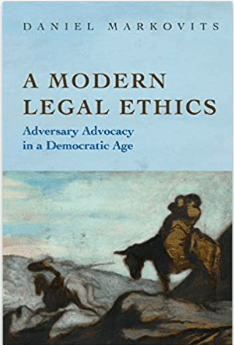
Daniel Markovits, A Modern Legal Ethics: Adversary Advocacy in a
Democratic Age  (Princeton: Princeton University Press, 2008).   The author is a law professor at Yale, and for
those of you who care about this kind of thing, he comes from a distinguished
family amongst the law school professoriate, and elite economists.  

Read More

LAWYERS AND LYING

All Lawyers Lie?

Michael Sean Quinn, Ph.D, J.D., Etc.

2630 Exposition Blvd  #115

Austin, Texas 78703

(o) 512-296-2594

(c) 512-656-0503

mquinn@msqlaw.com

The following comes from a
piece of fiction.  Many people believe it
to be true.  I have little experience in
criminal law, but I’m not so sure that it is true in civil litigation.

Everybody
lies. 

Cops
lie. Lawyers lie. Witnesses lie.  The victims
lie. 

A
trial is a contest of lies.  And
everybody in the courtroom knows this. 
The judge knows this.  Even the
jury knows this.  They come into the
building knowing they will be lied to. 
They take their seats in the box and agree to be lied to.

            The trick if you are sitting at the
defense table is to be patient.  To
wait.  Not for just any lie.  But for the one you can grab on to and forge
like hot iron into a sharpened blade. 
You then use that blade to rip the case open and spill its guts out on
the floor.

            That’s my job, to forge the
blade.  To sharpen it.  To use it without mercy or conscience.  To be the truth in a place where everybody
lies.

Michael Connelly, The Brass Verdict: A Novel 3 (New York: Little, Brown,
2008).  (This is a crime novel in which
the lead character is a criminal defense lawyer.  He has appeared in t least one more of
Connelly’s novels.

*********************************************************************************

This idea is vastly more common than one might think.  It is this because of a pervasive distrust of lawyers, even among those in the business classes.  In addition, there is a pervasive sense that advocacy is a type of laying, and it seems illegitimate to “the many”–as opposed to “the elite”–that advocacy for a proposition or person is somehow immoral, a type of lying, if the lawyers knows or believes that the proposition is false or the person other than he claims.

Here
is one of my doubts.  There are degrees
of lying. Connelly doesn’t seem to realize this. There is such a thing as
big, and there is such a thing as small.

One
of them is the out-and-out radical lie. (“I was not unfaithful to my
husband, at all ever, though he was to me, as he told me many times when I
would not haves sex with him, because I couldn’t.  He was too drunk.”)

And
there are regular lies. (“I did not run that light.”)

There
are more restrained lies. (“I don’t think I ran the light.”). And there
are levels of these, just are there are for each of the listed categories.

There
are lies of exaggeration. (“Last year, my wife weighed 216 lbs, before she
lost weight.”)

Exaggeration
has an opposite; it could be called lies of “Negative-ggeration.” These
tend to be on the small size.  Maybe it’s
because the “distance” between the degree of the lie and a zero-level of lying
is always smaller than if the lie goes in the “opposite” direction. 

Then
there are subtle lies.  These are different,
since they might be of various sizes. Big ones are great for impeachment;
little ones are not. 

Connelly
may be right that every real trial contains some of these.  It might even be that in a big money trial
every important member of the cast of witnesses tells at least one, at some
level or other.  But I think he is
suggesting that for every witness, there is at least one radical lie from that
witness. 

I conjecture that what is true for trials (and/or depositions” is also true for negotiations.  “‘Negotiative’ lying” is more subtle, but no less common, I’d bet.

I
doubt it, and I am not lying.  My
statement is not even a “restrained” lie.

QUINN’S THESIS: A SMALL LIE HERE & THERE
DO NOT REALLY ADD UP TO MUCH IMPEACHMENT. 
IT CAN LOOK OVERLY HOSTILE, SINCE IT IS SO COMMON.  HOWEVER, WHAT COUNTS AS SMALL DEPENDS ON THE
SIZE AND NATURE OF THE CASE.  A WHOLE
LONG LIST IS DIFFERENT; IT’S THE OPPOSITE.

Read More

Ownership: Who “owns” what? Ugh! & Yuck!

Michael Sean Quinn, Ph.D, J.D., Etc.

2630 Exposition Blvd  #115

Austin, Texas 78703

(o) 512-296-2594

(c) 512-656-0503

mquinn@msqlaw.com

A while back I wrote a blog (or maybe two) about irritable locutions lawyers should avoid using, especially in motions, briefs, and such. Consider “flagrant.” Not all errors or mistakes are this bad.  Or in social life. Consider “amazing.” 

Yesterday, I wrote something somewhere about the crass sounding saying “You’ve got it,” after someone has asked for something (ordered something in a bar or restaurant).  Obviously, the person asking/ordering does not have it, otherwise he would not be asking for it.

Now consider “own.”  Ownership implies property interest.  Recently, within the last few weeks, I have heard these phrases” 
Who owns the law? 

Who owns the Internet?

Who owns the future” 

“Own your future like you on all other aspects of you life. [If you don’t do this, you will end up asking the question no one wants to ask, ‘How did I end up here.’]”

Of course this is just a quick list from the last day or two.  The instances of misuse of much, much broader. The word “own” means all sorts of things.  I suspect it means something like “control(s)” or “strongly controls” or something like that. Parties to contracts do not own anything, although the contract may provide them with an ownership interest in something else.

The use of this word “own” creates all sorts of confusions.  Obviously, one cannot own ones children; to try to do this may lead to being charged with a crime involving sex trafficking. One cannot own another person any more, at least  in civilized countries–at least not legally, and ownership is an essentially legal idea.Of course, one can own “things” the Internet. Networks probably fall into this category.  There all sorts of traditionally conceived “intellectual property” to be found there. One has rights to them, and others have duties not to (something like trespass on them).

Lawyers should avoid jarring, confusing, questionable, even odd (unless attractive) in legal arguments and discourse. The multiple biz-class perversions of the term “own” are to be avoided.  If language is to be avoided in legal discourse of any sort, a lawyer needs to be careful about using it in other contexts.  The exception is the use of language which is known in advance not to used, like “That X is completely* fucked up. Who ever wrote it is a total  ______”  Using that sort of locution is perfectly* OK unless there is some other source of objection, the corruption of great grandmothers, for example. 

*Notice: I have avoided using the terms “completely” and “totally” in the same sentence.  Unlike the “Ugh!” and the “Yuck! with which I began.

************************************************************************The last phrase is really repulsive, though for a different reason.  People don’t own aspects of their lives; the idea is vacuous. People do own their investments–or, at least may for a time–but they do not own success of purchasing the right ones.  They may just have it–lucky them–or they may work to obtain it and succeed.  Those I actually envy.  I love mental success and follow-through. There is no ownership here.

More significantly, ownership does not imply success and non-ownership imply failure. Also smirking at the end-of life question posed is nothing more than pissing on creativity, adventuresome and risk.  The chances I would use that stockbroker or his disciples as mine as zero, the chances I would recommend anyone that else does are even less, as area of eternal life to which some people have happily wished I would go with dispatch. (Charles Schwab, who has named a stock brokerage chain after himself, is the worse public offender.  See his “commercial” on PBS, 2014.)

Read More

Quinn Quotes

Legal systems are inherently conservative. One reason is that one function of legal systems is to make stability likely; that usually requires a reasonable, cooperative, disciplined, and peaceful society. Any cooperative order requires honesty and defeats radical individualism  Furthermore, social stability almost always requires that the present and often some of the further to resemble the past, even if its supports pluralism and the cosmopolitan.~Michael Sean Quinn, PhD, JD, CPCU, Etc.Tweet

The books shown are NOT affiliate links.
MSQ (site) does not receive any compensation for books listed or sold.
Books are shown for the reader's convenience only.

Newsletter

Michael Sean Quinn, PhD, JD, CPCU, Etc*., is available as an expert witness in insurance disputes and other litigation matters. Contact
