THE GOOD LAWYER Part IV: Willpower

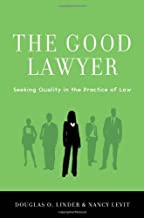
Douglas O. Linder & Nancy Levit. THE GOOD LAWYER: Seeking Quality in the Practice of Law. Oxford University Press, 2014, with an enormous bibliography to be found in the footnotes. My exposition, commentary, and critique will be presented in several parts. This one is on background and foundations.

Part I

This part pertains to foundations, topics, and most important sources. Other parts concern other specific matters and will be organized by questions about, commentaries on,  and therefore arguments with different chapters.

Part II, already published, is about Chapter One of the book, and that chapter was about the good lawyer, empathyand the good lawyers’ being empathetic.

Part III, is about Chapter Two, and it is about courage, being courageous, and being a  good lawyer.

“No really lazy person can be a good lawyer.” —MSQ

Part IV, this one, is about willpower, and it is closely connected to Part III by reason of the fact that courage and willpower go together naturally. (Of course, willpower is connected to everything lawyers do, for no consistently good lawyer can be lazy and weak when it comes to devotion to get the relevant work done, even the authors do not actually say this.

One of the central theses of Chapter 3, “The Good Lawyer Has Ample Willpower,” is the crucial importance of persistence of two forms of willpower: the I will [do it] power & the I won’t power.

Unsurprisingly, the authors focus substantially more on the “I will” than they do on the “I won’t,” although they say a little bit about resisting temptations, such as alcoholism. (Do they actually think that an alcoholic cannot be a good lawyer? Really?)  Either way—“will to,”/”will toward”/”really-leaning-into” or “will against,”/”will away from”/”leaning against the headwind, as one might put it—could be characterized, as the authors do, as creating a “habit of goal achievement.”  (I have long put it this way: “Habit is created by willful repetition.”)

It involves self-discipline, what might be called overcoming the wandering mind and thereby extinguishing “monkey mindedness,” as some have called it, limited goals, and the avoidance of perfectionism (Examples: Enough is enough; Near best is often good enough; Nearly losing is often OK; Acknowledging that closes losses are the best that one could do.) In addition,persistence requires having the right “mindset,”  and it must involve growth. Self-knowledge is needed, as—in some ways, the mostinteresting optimism.

The authors adopt the concept of mindset from a book of that title, MINDSET, published by the De Capo Press in 1989. The author, Ellen J. Langer, Ph.D. is an award-winning, extensively published psychologist on the faculty at Harvard, and—of course—that means that she is wise, wise, wise. Besides, three pages of known high-prestige professionals endorse the book in its first pages; one of them is Alan Dershowitz, and the authors would probably nominate him to be a good lawyer.

Persistence for lawyers is especially important for the relationship virtues, empathy, courage, tolerance, realism, etc., but it is also important for simple mental activity, since lawyering is a “particularly mentally, demanding activity. But, the authors point out, that lawyerly business of mind, all other professions involving making “decisions requiring conscious and sustained thought,” and “mental busyness has its costs.”

I especially both love and hate this chapter.  I love it because the ideas are encouraging. Then again, I have a tendency to likeself-improvement books, if they are not too “Seven Steps to. . . .”-trash. I love the chapter since much of it seems right as well as right on. I love this chapter because it is really about things that lawyers need.

I hate this chapter because it makes me feel inadequate and absent from the fleet of really good lawyers and that leads to shame resulting from what I could have done and from false self-presentation.   I am only erratically persistent; I cannot completely avoid perfectionism, even in judging others; and I am less than optimistic. In fact, my wife, also a lawyer, thinks I am pessimistic. I have to grant her a degree of that truth since I conceive myself as only being partially pessimistic, and I believe that rational realism requires a fair degree of pessimism, but she denies this based on theological reasons, deep faith, and a greater devotion of religious spirituality. (Of course, any good lawyer can have that, though I think the authors give no hint that either it or its opposite would, for any reason, be highly correlated with being a good lawyer.)

In addition, I am not sure I have the right mindset and I am money-minded with a vengeance.  I can testify that it is very distracting and tends to build all sorts of negative characteristics, including distractedness, a sense of mental inadequacy, stress, and anxiety, among others.

Nevertheless, I must wonder a question, even in the context of what I love about this chapter.  Is it really true that all decisions require study in order to make those decisions? In a situation like trying a case, a number of decisions must be made instantly, or close to it. Whether to object to a question is one of them. Whether to ask certain questions is another? The tactic of whether to lead a witness may be made in advance and involve thought; on the other hand, some do not.

The authors probably already believe this and see it treated in their account of intuition discussed in the next chapter.  That is certainly true. Sound instantaneous decisions usually arise from experience and tend to entail that there has been reasoning about related matters, and it emphasized the importance of intuition. In other words, it emphasizes both “dual reasoning”and “duel reasoning. 

Read More


THE GOOD LAWYER , Part VI – Realism

Douglas O. Linder & Nancy Levit. THE GOOD LAWYER: Seeking Quality in the Practice of Law. Oxford University Press, 2014, with an enormous bibliography to be found in the footnotes. My exposition, commentary and critique will be presented in severalparts. This one is on background and foundations.

Realism

This is Part VI. Part I should be read first. It pertained to foundations, topics, and most important sources. Other parts which concern other specific matters will be organized by questions about, commentaries on, and therefore arguments with different chapters. Part II, already published, is about Chapter One of the book, and that chapter was about the good lawyer, empathy, and the good lawyers’ being empathetic. This one, Part III, is about Chapter Two, and it is about courage, being courageous, and being a  good lawyer. Part IV is about willpower, and it is closely connected to Part III by reason of the fact that courage and willpower go together naturally. (Of course, willpower is connected to everything lawyers do, for no consistently good lawyer can be lazy and weak when it comes to devotion to get the relevant work done, even the authors do not actually say this.)

This Part, VI, is about Chapter 6 of the book, and it is entitled, “The Good Lawyer Thinks Realistically about the Future. Therefore, realism in the sense of realistic thinking, is deeply embedded in the minds of all good lawyers.

This is an outstanding chapter in the book. Remember! My discussions are not meant to tear at the spirit of the Linder-Levit treatise. As I have said repeatedly, it is a kind of written philosophical, Socratic dialogue.  That’s why I mostly ask questions.

The central idea is that people need to get realistic about their own performances and all good lawyers actually do it.  Now, think about what the term “realism” means in this chapter. Hint: it is not the way the terms are used in aesthetic discourse.Question: Does that matter in understanding what is being suggested here? As implausible as it may sound, I think so.

Still, why should the realism of the sound thinking of lawyers be tied to the future?

Shouldn’t it also tie to the past? Of course, understanding the past now is like treating it as if it were the future since it is new to the person trying to come to an understanding, is it not? Or is it? Consider a historian that knows a given century well, but has decided that she does not really understand it, but has been insufficiently realistic and decides to start over again.

Authors: People tend to think that they will achieve better results than they actual will. They overestimate the odds of their achieving their goal at all, and even if they achieve it, they exaggerate how much further they will get. Predictions do notautomatically get better with experience. “Overprecision” and overconfidence together. “Over-precision. .  . is ’excessive certainty regarding the accuracy of one’s beliefs.’”

In predicting outcomes, lawyers “’unrealistically close to best-case scenarios. But most lawyers live in “’low-validity environments,’” meaning that “the level of uncertainty is high.” In addition, uncertainties work like a cascade or a pile-up. Intuitions are not to be trusted in low-validity environments. The “’ disciplined collection of objective information can improve the accuracy of predictions.’”

This can include lots of different kinds of information. The authors cite someone who suggests that plaintiff’s lawyers do not study statistics of win rates for given types of cases, and imply that they should. (Is it interesting that many insurers and coalitions of liability insurers do exactly that and have for years on end? Of course, that won’t work in revolutionary situations, like the asbestos cases.)

As a practical matter, the authors argue that being able to think in terms of probability is characteristic of the good lawyer.  This means that they need to learn how to:

use decision trees,frame the issues they are thinking about,resist the temptation to draw the frame too narrowly,realize that the probability of conjunctions of events is lower than the probability  of at least one of them taken alone,imagine the future accurately,avoid believing that their thoughts and feeling in the present should shape their conduct in the future,think about the future by imagining how someone else—a surrogate–might think  about it or react in it,use game theory when thinking,and so forth.

Only part of the applications of all these ideas is litigation.  It includes many sort of planning for clients, e.g., estate or business. Using these modes of thought can help discharge the duty of the lawyer.

And the authors add another dimensions: “A good lawyer has something of the wisdom of the Zen master.” The idea here seems radically different from any other  kind of legal training I’ve ever heard of, but intriguing. I don’t think they are talking about having clients sitting sort of cross legged on the floor of the office and humming. I think they are talking about teaching lessons about facing unexpected reversals, adversity storming out of unpredicted, and the satisfaction inherent in knowing how to pass on by.  Of course, this is not simply “Zen-ery”; it is also “Stoicism Without Glum Acceptance.”

It is clear, however, the teaching of a philosophy of life in the context of advising clients as to legal and related matters.

One wonders if this should be presented in law school curriculum’s. Of course, there are other philosophies of life applicable in situations like this, e.g., religious ones.  Are there situations in which such a situation is absurd? What about dealing with alikely-to-be-convicted murder defendant. “Look at it this way Sophia, you are likely to be convicted of killing your three children and each of their fathers all at once, but you will probably be sentenced to death.  However, it can cut that down to get only six life sentences without parole. Relax and accept your fate.”

Isn’t it also true that lawyers lie about their achievements, e.g., in litigation?  “We didn’t actually win, but our client washappy.” Or “satisfied with the settlement.” How often do people hear a lawyer say, “I lost and I am soooo disappointed.” Or, “I got my ass kicked, and I am so ashamed.” Or, “I feel so guilty.”

Authors: The rate of uniqueness is overestimate. MSQ: Here! Here!

Authors: The good lawyer is realistic in thinking about the future.Quinn: What does the last sentence mean? Candidates:

Realism about the future is a necessary conditionfor all good lawyers.Realism about the future is a characteristic allgood lawyers share.There is no such thing as a lawyer who is good andwho is unrealistic when analyzing and drawing conclusions about the future.

Read More

THE GOOD LAWYER, Part II – Empathy & Being Empathetic

Douglas O. Linder & Nancy Levit. THE GOOD LAWYER: Seeking Quality in the Practice of Law.  Oxford University Press, 2014, with anenormous bibliography to be found in the footnotes.  My exposition, commentary, and critique will be presented in several parts.  This one is on background and foundations.  This is Part II; Part I should be read first.  It pertained to foundations, topics, most-important sources. Other parts concern other specific matters and they will be organized by questions about commentaries on, and therefore, arguments with different chapters. 

Empathy & Being Empathetic

The authors reject the proposition that empathy is having a feeling.  Empathy is characterized, by the authors, as “the capacity to assess the internal life of another person.  Empathy allows us to stand in someone else’s shoes, feel what the person is feeling, appreciate what he or she values, and responds appropriately.”  It underpins the “human disposition to altruism and compassion” “Empathy can jar us out of thoughtlessness and indifference and focus our attention on the human consequences of our decisions.”

I personally like, “affectionate,” every word of these foundational theses.  But don’t the authors make empathy a capacity to havea feeling and then to have it, namely, that of the other fellow?  Don’t they do this explicitly and by implication? 

How am I standing in the shoes of another if I do not have feelings more-or-less identical to his, at least in substance?  However, in order to be empathetic to a person whose teenage son, say at 15, just hanged himself for unknown and not-understood reasons, do I have to experience an emotion even close to his?  

I understand grief in all sorts of ways, but must I have his grief, as it were?

Now for other questions:

Is the authors’ idea of empathy, being empathetic, or even striving at an advanced level for having empathy characteristic of a good lawyer? It certainly is not a necessary condition of excellent or even good lawyering, true? Is correlated with greatness in lawyers? Would a lawyer who mainly represents large companies in business deals with other large companies have this characteristic?  Is it even characteristic of them?  Should those who don’t have it, who spend 100% of their time working on behalf of the interests of large corporations develop the virtue of being empathetic in order to serve their clients loyally, zealously, within the law, advising and counseling as to their best interests?  Need they do this?  Of course, one can have empathy for a less-than-human animal, e.g., one’s dog, for his/her pain, confinement, loss, etc., but isn’t having the same empathy restricted to living beings?What about judges and empathy?  Isn’t it the case that the empathetic judge may have a susceptibility to bending the law in inappropriate ways and/or the facts?  Sure, they must have some; otherwise, wouldn’t they be hard-hearted? This chapter ends with a list of 12-item checklists.  Is it reasonable that they should all be devoted to situations in which human persons are the client?  Is #7 on the list really an acceptable general principle?  “Avoid legal jargon, lectures, and long-winded answers?”  Granted “long-winded” should be avoided, but what about “lengthy?” Consider this: “When dealing with a large company seeking advice and counseling on complex, sophisticated transactions, make sure those being addressed understand what is said, actually need lengthy answers, might want outlines to be handed out but don’t want the answers to be longer than they need to be?  But is this empathetic?  Or is it something else, and if so, what?If one’s client is a large corporation, is empathy for the corporate folks required for being a good lawyer?  If so, to whom does it run?  Employees?  Top employees?  The officer at the top making ten times what the next person down makes?  But also, the source of most good ideas had a significant charisma (the job type, the narcissistic man who thinks he is Steve)?  Whatabout directors?  Shareholders?  Bondholders?  For how many people in a group can anyone have empathy in a given situation?I have done a lot of work for insurance companies as to coverage and when to settle large cases if they should be settled at all.  Isn’t it a good idea for me to know the feelings and nature of the plaintiffs, the victims, and maybe their lawyers, in at least some cases?  Might this not be more important than knowing the true feelings of the insurer and/or the insured?When bad faith in insurance adjusting is the central issue, it seems that I can exercise my obligations to my client, thethe insurer, only if I know something about the mind of the relevant adjusters.  Maybe something about her or his feelings?  Frequently I have had to know about their biases and last objectivity.  To what extent do I have to understand their feelings?  I certainly have to understand their mistakes, if any, and why they were committed.  If the adjuster has fouled up and is frightened of dismissal–say because she is 50–don’t I still have a duty to my client to explain?  What do I think happened, even if I condemn the adjuster to dismissal?  Even if I love the adjuster deeply as a person?  (Suppose she has been like a mother to me in teaching me the claims side of the insurance business?)  If the adjuster was handicapped by having racial contempt, do I have to know about this?  Do I have to have empathy for him or her?  (Nota bene: I have not seen that explicitly, at the surface, in many years, but aren’t their other prejudices, e.g., the victim is too fat.  Admittedly, in liability situations, that can be relevant, but it is much less likely to be when applied to the insured, the defendant.Are there different dimensions, or components, of emphasis?  Could one have empathy for a person contracting a disease,but not a husband or wife having infidelity inflicted upon them?  Empathy for a drug addict but less for an alcoholic, or one with a light case.  Are there degrees of empathy? Acute versus superficial?  Intense versus mild?  Deep versus shallow?  And so forth? If so, are there particular dimensions a good lawyer ought to have, do have, most have, that are correlated to some relative degree, at least, or must-have?  Are there degrees of empathy, or being empathetic, which are required or are highly correlated with the goodness qua lawyer?  Is it the case that dimensions and degrees of being empathetic can be mixed together, and if so what is the ideal mix for a good lawyer?  Or the OK mix?  Are these really questions that a book like this one should be treating?  Maybe not.Is empathy really about being a good lawyer or it is about being a moral person–a good person–and/or about being a good citizen–also, probably, a dimension of being a moral person?Can a cynical lawyer be empathetic?  Upon what sorts or degrees would this depend?  What about a truly skeptical lawyer?

I repeat I am completely sympathetic to the view and exhortation of the authors, at least when it comes to representing persons.  I have found this to be so in personal injury cases, divorces, employment, and discrimination cases. 

However, it is often their feelings that stand in the way of reasonable settlements that are in their best interests.  A good lawyermay sometimes have to have the discipline to tell them to “Get over it.”

At that time, I value the authors’ love of stories and storytelling; it was fun and deep to do and is satisfying to hear.  As a long-time reader of novels (that I finish if they are not too boring and not too long), a watcher of movies (even films), and a passionate attendee of live theater, I love stories and I have since I was a child. 

At the same time, I am an unbeliever.  Even a well-told story with a terrific plot often leaves me in doubt as to the probability of its theme being considered as thesis, although not as to beautify when it comes to structuring and to language. 

Indeed, much of the best literature creates unanswered questions that are sometimes unanswerable.  Is this what stories to clients and stories to juries ought to look like?

I know from reading his stories that Linder’s mentor and one of his heroes is a great lawyer and maybe a good one.  I love his position regarding the centrality of stories.  They focus attention, to some degree.  They grab to the heart, again, to somedegree.  But Spence does not seem to recognize that ifs his telling the story that makes the difference, at least as the obtaining a high degree of focus and a great grab, and not necessarily the story itself.  I’m not sure he has distinguished talent from the tool.

I have seen lawyers trying to follow or be Spencerian, and most of them are terrible at it.  For the sake of justice, never, never, never try Spencerian argument in an appellate court or a trial court like most U.S. District Courts, if there is no jury at hand.  Lawyers do not serve their clients when they tell stories in the “Pirsig Mode”–too long-winded, for one thing.

*************************************************************************After Thought September 16, 2014 The former Archbishop of Canterbury had an interesting set of lectures this year a while after he retired from his bishopric. It was about EMPATHY. 

He expressed some skepticism about empathy being one of the central ideas regarding sound moral and ethical thinking. First of all, it diverts attention from ethical problems arising not from individual persons but from whole groups (ISIL–my example, not his). It does not focus on the victimization of whole groups and/or classes; not everyone will feel the same way about suppression, about the injustice of unjust wages (again, my example, not his). And he treats other matters as well.   This leads me to do some philosophical reflection on the idea. (1) I wonder if empathy always includes sympathy? (2) Does having empathy for suffering always lead to a duty to help? (2) Does having actual empathy always imply that the victim whose pain you feel has been treated unjustly? (3) Can hostility be founded on empathy under some circumstances. (“I see you experienced both joy and guilt as a result of cutting that child’s head off after you tortured her and abused her sexually. I feel your pain.”  What now?) (Should prosecutors always feel empathy for the criminal? Never if guilty? Never is unremorseful? If filled with self-hatred which is well deserved?) Now for a kind of political question involving empathy, maybe. (4) Assume ISIL volunteers believe that their national and ethnic groups have been unjustly treated. Assume further that they believe that executing westerners is a not-so-good but necessary way to get the attention of the west, e.g., the U.S. They are filled with hatred and rage, perfectly understandable, given their political views.  Should we have empathy with these guys, granting that they are very bad guys? Some have the attitude that the western response should include the following.  Indicate what is coming. Demand the turn-over of the actual executioners. The demand of ISIL is that just POW rules be adopted forthwith and applied insofar as even possible to civilians. They will almost certainly not consent to this, and one still might feel their pain.  At that point, it seems to many that western forces, e.g., those of the U.S., could reasonably adopt a policy of ~POWs will be taken. Could this possibly be a just position, forgetting about whether it would be a sound military strategy?  Would the obligation to have empathy for those who have been downtrodden permit this sort of decision?  

Read More

THE GOOD LAWYER, Part III: Courage

Douglas O. Linder & Nancy Levit.  THE GOOD LAWYER: Seeking Quality in the Practice of Law. Oxford University Press, 2014, with an enormous bibliography to be found in the footnotes. My exposition, commentary, and critique will be presented in severalparts. This one is on background and foundations.  This is Part III. Part I should be read first. It pertained to foundations, topics, and most important sources. Other parts concern other specific matters and will be organized by questions about, commentaries on,  and therefore arguments from different chapters. Part II, already published, is about Chapter One of the book, and that chapter was about the good lawyer, empathy, and the good lawyers’ being empathetic. This one, Part III, is about Chapter Two, and it is about courage, being courageous, and being a  good lawyer.

The Authors describe courage as to have three dimensions:physical courage, moral courage, and psychological.  They describe courage writ large as a “virtue.” I love this term, so long as it is kept distinct from virtual. It seems to me that all of the properties of good lawyers the authors discuss are virtues, but the word and hence the concept are most clearly employed in discussion.  Of course, the book is describing several components of overall human virtue, if there is such a unified thing.   In other words, it is discussing a number of virtues. The authors submit that all of them are characteristic of all good lawyers.  Itis appropriate to remember that virtues have for 2300 years, or so, usually been thought of in terms of “means,” which is something like an average.  “Courage (both of the moral and physical variety) is best thought of as a mean between the extremes of timidity and recklessness.”   The idea of virtue as a “mean” comes from Aristotle when it comes to influencing in the history of philosophy. But while many big-time thinkers have thought of it that way, though in “Upper Crust Square,” in the monastery, or at the religious colleges (e.g., Notre Dame,  Baylor, and so forth) at least some virtues were not thought of that way at all. Readers of nineteenth fiction know this well. For many centuries, if a woman had sex with a man other than her husband, she was not a woman of virtue. If a married man had sex with a woman who was not a woman of virtue or hung around with her or them, he was not a man of virtue. In any case, the authors, if only impliedly, think of them as linked to Aristotle, but does their concrete discussion really look like that? Is their idea that good lawyers have guts. This is an attractive and even inspiring idea, of course (I myself worshiped these ideas in my relative youth), but one wonders if the idea is tainted by the paradigm cases the authors emphasize: civil rights lawyersand criminal lawyers defending unpopular defendants, where those defendants are deserving of defense and vindication? 

These lawyers have guts, alright, though they may not be the only type, but what about the legions of lawyers who seem not to, the lawyer who do  run of the mill plaintiff’s auto accident cases,     relatively routine commercial real estate transactions, everyday corporate gatekeeping advice and counseling,   routine dealings with state regulators where the client is trying to avoid administrative litigation,   motions practice in complex litigation, appellate briefing and writing withoutappearances, and  so forth?

These are areas where courage does not shine, are they? The lawyers don’t have the real guts of the people the authors mention. Can’t such lawyers actually be quite good lawyers, excellent lawyers, and even great lawyers at what they do? The great appellatelawyer is a truly extraordinary lawyer. These are surely not classifiable as “cowards,” which is often what people without courage are called, is it not?  Indeed, might their position one the authors reckless to timid scale as having a mean within some range. (Maybe I’m not being fair here. Maybe there are 50 degrees of measure.  Maybe there is, contrary to what the authors say,  reckless courage at one end and then complete cowardness—not just timidity–at the other end, and then lots of degrees along a scale in between? Or maybe that’s not fair either: how can reckless courage even be thought to exist? The authors appear not to think so.) The authors have, from my point of view, within the authors’ framework, there are three instances of what they call “moral courage,” that are the most interesting.  The first one is telling a client that the worth of the case has been overestimated and that it would be advisable to discuss settlement or throwing in the towel. (If a client thinks it has $0 liability but has $1 liability, then the value of the client’s case has been overvalued.)  The second is telling the client that s/he is much more at fault than s/he thought s/he was, or—at least—presented himself. (Of course, the client may be an “it” and not a s/he.)   The third one is the lawyer confessing an error to the client. This last one does not happen often, and it takes real courage, as confessions often do.  A POSTSCRIPT: 

David Brook wrote a column in NYT on 8/28/14 entitled “The Mental Virtues.” He listed the following: love of learning,  courage, firmness, humility, autonomy, & generosity.

He says he got these from the 2007 book by two professors, Robert C. Roberts (Baylor University) and W. Jay Wood (Wheaton College) entitled INTELLECTUAL VIRTUES.  The intellectual virtue of courage involves the willingness to hold the unpopular views and a refusal to jump to conclusions even when there are pressures in the opposite direction. “Intellectual courage is self-regulation. . . [that is,] knowing when to be daring and when to be cautious.” The next topic is willpower.  It matches up with courage quite well.  As I see it,  being courageous and having the habit of some sort of courageousness requires substantial will power and the same is true for having habits of courage.  

Read More

Cyber Insurance Policies and Their Characteristics

Some Significant & Representative Cyber Insurance Cases:  Second Period & Its Dénouement

There are not very many reported cyberinsurance cases, as was already noted in my account of the First Period, PartI,  published today. There areplenty of civil (and criminal cases) about the so-called cyber-world, butdirect, focused, coverage, or similar, cases are very few in number—almost nonein the Twentieth Century.   There aremore in the early Twenty First Century, but as they have evolved, the topics ofthose cases are probably passé.  I havealready spelled some of this out in Part I.There are many more cases now; thatarises from (1) the exponential growth of computer technology, following whatis called “Moore’s Law”—something which is not a scientific (or any other kindof )law at all, (2) the increasing number of diverse insurance policiesoffered, sold  and bought, and (3) thegrowth of the market’s need for cyber-lawyers.Category (3) to a degree of certainty vastly exceeding that of  Moore’s Law, where the market wantstransactional lawyers, it will need litigation lawyers.

I.Some Cases ofthe “Second Period”

1.  Netscapev. Federal [i]The first caseto be discussed,  NetscapeCommunications Corp. v. Federal

Ins.Co.,2007 WL 2972924 (N.D.Cal., October 10, 2007), reversed and remanded,

343 Fed. Appx. 271 (9thCir.  2009) [Parallel Cite: 2011 WL2634945]. will be of

continuingimportance, even though it is in certain ways not amongst the most important.(After all, it is not in the “first cut” ofWest’s Reported Cases.)Nevertheless it is frequently cited, and it’s focus of “of the times.”

Inso-called real world policies, there is something called “Coverage B.” It’smost recognized habitat is in the CGL policy, though it is now in manypolicies. It is entitled and called “Personal Injury and Advertising Liability”coverage, and the “Personal Injury” component covers at least some  events as false arrest, malicious prosecution,wrongful entry, some defamations, and some violations of privacy, while“advertising injury” covers other defamations, product disparagement,misappropriation of advertising ideas, copyright, patent, and/or trademarkviolations.  Some of these injuries gotsubtracted over time; some were (at least in effect) added; and some werechanged. Patent violations are a paradigm of a subtraction.

Fairly obviously some of these fit into theso-called cyber-world perfectlyTosome degree privacy, and related topics, may now be the most important coveragearea ripe for coverage disputes.  So ascopyright violations. As are trademark infringements.

This case is not the firstquasi-reported cyber-world case, it is not at the highest level reported, noris it the most cited case. It is important because the district court recitesthe facts in some detail; applies legal reasoning taken from the so-calledreal-world, and then makes historically significant reversible error regardingsemantic reasoning.  Finally, itssignificance seems to have been generally misunderstood.America Online (AOL) and its subsidiaryNetscape Communications Corporation sued Federal Insurance Corporation allegingbreach of contract, common law insurer bad faith, and Unfair Competition inviolation of the California Business and Professions Code  §17200.The case was decided on cross motions for summary judgments on the topicof the insured’s right to a defense from St. Paul.

Netscape demanded that St. Paul defendit in four private civil actions.  Thosesuits alleged at least interceptions of private electronic communications.  Each of the underlying suits concernedNetscape’s “Smart Download Product,” a software program designed to facilitatethe ability of third party users to download large files over the Internet byenabling them to resume interrupted downloads from the point of interruption.The program contained a feature, “Smart DownLoading Profiling,” which providedNetscape with information about users’ internet activities. Netscape used thisinformation to create profiles of its users, both to help with technicalsupport, and to create opportunities for targeted advertising.

At first the policy “excluded coveragefor advertising injury or personal injury such as invasion of privacy claims.”Netscape was added to the policy when it was acquired by AOL in 1999.  The district court summarized parts of thepolicy pertaining to what has been called “personal injury” for a long time inCGL and similar policies. Invasion of privacy was part of the insuring agreement.  Among the exclusions was one for “personalinjury for ‘online activities.’”

A major substantive question pertainedto a single exclusion in the policy, namely the “online exclusion.” St Paulcontended it applied, and Netscape denied it.In particular, Netscape argued that “the exclusion does not applybecause SmartDownLoad did not involve ‘providing access to 3rdparties.’” The exclusion section states that “for the purpose of advertisinginjury. . ., all Online Activities are excluded from these coverages.”

The district judge examined the policyand the English language and on those bases found that “the plain meaning ofthe term ‘online activities’ included those products and services that provide,allow for, and facilitate access to the Internet and its content. Some of thelanguage examined by the court was in an endorsement, and it said:  “‘[p]roviding e-mail services, instantmessaging, 3rd party advertising , supplying 3rd partycontent and providing internet access to 3rd parties.’”  (Emphasis added.)

The court took the word “access” to bebroad, and broader than “connection.”Providing a connection meant providing a way in.  “‘Access’ included not only the permission orability to enter as ‘connection’ does, but also the freedom or ability to makeuse of something.”  The court concludedthat since the plaintiff’s were providing software that facilitated purchasersto come on to the Internet, the seller gave them access to it.

The district judge took these points tobe based on the clear language of the policy. He went further, however, andposed a hypothetical supposing that since the meaning of “access” is ambiguousso it would have to be interpreted in favor of the insured, assuming that theinsured did not propound and probably actually “write” the relevant passage.  But it is not ambiguous, that analysis needinvolve nothing but cogitation on the purely hypothetical.

There was one other question the courtdecided.  It was near its mainpoint.  This subsidiary point regardedthe meaning of “access,” actually resolves of the main other point. The policyprovided liability coverage for “personal injuries,” and that idea included“[m]aking known to any person or organization, written or spoken material thatviolates a person’s right to privacy.”

The court indicated that it would have held,but for the exclusion just discussed, that Netscape had a right to a defensefrom St. Paul.  After all, Netscapepassed information to the parent company, its employees, and persons at AOL.

The court at least impliedly held thatif the exclusion functions as the court held that it did, then there is no needto reach the “Make Known to Any Person or Organization”  language of the policy.

The Ninth Circuit panel that reviewedthis case, rejected the decision of the district court without ceremony.  Considering in reverse order, the panelrejected the trial court’s interpretation of “access.”  It held that common usage in the language ofcyber world discourse does not include the acts of “SmartDownload or the acts ofAOL as providing ‘access.’” The common usage equates “access” with providing anInternet connection. Thus, the selling of a product which a buyer could use tomake a connection is not making a connection, and thereby providing access, tothe purchaser. That eliminated the exclusion.

Now for the insuring agreement. Theplaintiffs in the underlying case pleaded a breach of privacy.  To be sure, it is an unusual, non-traditionalversion of someone’s having a right to privacy, but the coverage language inthe policy was broad. So, as the district judge said, this case was pleaded insuch a way that fit within both the legal conception of a right to privacy andthe language of the contract.Unquestionably, AOL internallydisseminated “private online communications” to some persons.  A few courts have held that these kinds ofdisclosures do not constitute an invasion of privacy.  But those decisions assert this only “indicta while deciding whether the personal injury clause covers invasions of‘seclusion privacy’ claims.”  No suchcase has been decided in a context in which the policy language employed theword “any,” and the district court was exactly about how to think about thatword.[ii]

The decision of the district courtwas reversed and remanded.2.RetailVenturesThe facts—the plot–in the underlyingcase, the case upon which the coverage case is based, are familiar.  Hackers invaded the computer system of  Retail Ventures, Inc., DSW Inc., and DSW ShoeWarehouses, Inc. on February 1 and 14, 2005 using the local wireless networkand one of the stores to get to the main system.  They “walked off,”—downloaded—credit card andchecking account information for 1.4 million customers and the underlyingdamages were stipulated to be $6.8M.  Fraudulent transactions had followed thehacked invasion, but the hackee was notified by some credit card companies onMarch 2nd.   Retail Ventures Inc. v. National Union FireInsurance Company of Pittsburgh, Pa., 691 F.3d  821 (6th Cir 2012).Retail Ventures’ damages resulted from thedata breach included “expenses for customer communications, public relations,customer claims and lawsuits, and attorney fees in connection withinvestigations for sever state Attorney Generals and the Federal TradeCommission.”  The largest part of theloss, $4M, “arise from the compromised credit card information: namely, costsassociated with charge backs, card reissuance, account monitoring, and finesimposed  by VISA/MasterCard.” The FTCcase was settled by Retail Venture agreeing to set up and deploy better cybersecurity equipment.One important feature facts surroundingthe hacking incident involved were not an issue on appeal, at least in part,because the criminal had been identified.In February 14, 2005, someone used a local wireless network at a localDSW store, obtained access to the main computer system and downloaded bothcredit card and check  information for1.4 million people that shopped at 108 of the DSW stores.  Fraudulent transactions followed.  DSW was alerted on March 2, 2005, they beganan investigation, and notified AIG quickly.AIG reserved its rights and investigated.The insurance policy involved was anendorsement—a rider—covering computer fraud attached to a “Blanket CrimePolicy.”  Here is a case where thepolicy, considered as a whole covered both to be found in the real world anddamages to be found in the real world but the causes inflicting the injuriouseffects through the use and then the causative flow to be found in the cyberworld.  What was found in the cyber worldwas not injured; no network was destroyed, for example.   It should also to be noted that that nobodily injury and no physical injury was inflicted on anything or any person inthe so-called real world.  It wasfinancial or economic only.

The insured incurred substantial expensesoccasioned by the data theft, for example: matters of customer communications,public relations, customer claims and lawsuits, attorney fees in connectionswith seven (7) government investigations by state Attorney Generals and theFTC.“FTCinquiry was resolved administratively with a consent decree, inter alia, that plaintiffs [DSW]establish and maintain a comprehensive information security program designed toprotect the security, confidentiality, and integrity of personal informationcollected from or about customer.”

Theevent and the follow up cost DSW more than $4M for“costsassociated with charge backs, card reissuances, account monitoring, and finesimposed by VISA/MasterCard.  That amountwas determined by the settlement of plaintiffs’ contractual obligations withcredit card processor, National Processing Company, LLC (a/k/a BA MerchantServices, LLC.”)

AIG denied coverage on severalgrounds.  The denial letter “questionedthe ‘location’ of the loss; it stated that the loss appeared to be ‘excludedbecause it related to confidential customer information’; that this was an “‘indirectloss,’” and so not covered.  Theplaintiff responded by providing further information. AIG modified its positionbut continued to deny coverage on the ground that the claims “arose  from ‘third party theft of proprietyconfidential customer credit card information.’”

Both the insurer and the insured soughtdeclaratory judgments.  Setting asideother issues, the only coverage issue involved a piece of the cyber theftendorsement to the blanket crime policy entitled “Computer & Funds TransferFraud Coverage.” The insurer agreed in relevant part to pay the insurer for:Loss which theInsured shall sustain resulting directly from: the theft of any Insuredproperty by Computer Fraud.

The phrase “Computer Fraud” was definedas including several alternatives, one of which was “‘fraudulently accessing ofsuch Computer System[.]’” The phrase “Insured Property” includes property theinsured owns or holds, whether or not the Insured can be held liable for whathappens in this situation, i.e., owning or holding.

AIG did not disputeunauthorized access or that there was “Computer Theft” involving “InsuredProperty.”  What was disputed was whetherthe insured’s loss was one “resulting directlyfrom the theft of insured property by computer fraud.”  (All of the underlining of “direct,”“indirect,”  “directly,” as well as“indirectly,” have been added for emphasis.)

Interestingly,the role of directness is built intomany cyber-policies, and many believe that the holding and reasoning in DSWindicates that a storm in coverage litigation is coming.In this case, AIGadvocated that the endorsement was really a fidelity bond.  That argument failed quickly.  The issue of directness was the mainissue on appeal. AIG took the position that “direct” means sole andimmediate cause, or what is sometimes called “Direct-Means-DirectApproach.”  The court rejected thisview.  To some extent it has been used infidelity bond cases, and has not always been sued there.  Instead, the court took a different approach;it adopted the premise that “direct” does not unambiguously incorporate thedirect-means-direct approach; rather that the policy language makes itambiguous.In contrast to AIG, DSWargued that “direct” means “proximate cause.”The court seems inclined toward that view but was nervous about adoptingit without a specific holding in the Ohio Supreme Court to that effect.

AIG gave two morearguments with which the court seem impatient. One is that there had been anexcluded “loss of propriety information, Trade Secrets” etc. The court gave avariety of reasons why this argument could not work. One of them was that thoseconcepts apply to the internal business operations of the insured.  Of course, nothing like that was involvedhere.[iii]

3.     Zurich American v. SonyCorporation

This case begins with ZurichAmerican (Zurich), and a number of other insurance companies filing a Complaintseeking a declaratory judgment on a breath taking disaster at the SONY. Itfocused on both the various SONY entities and other insurers. Zurich American Insurance Company, et al v.Sony Corporation, et al (Sp. Ct. N.Y. (Trial Division)) #651982/11. (July20, 2011). For reasons related to actual historical sequence and significance,this case is discussed before cases decided after it. It is my understandingthat SONY filed a similar case in California.

It all arises out of the now famousPlayStation 2011 debacle resulting from massive hacking of gaming networks(a/k/a a form of gambling?), together with networks inviting customers topurchase and download games, music, movies, and so forth.  For entry into these cyber-dens, customershad to make certain disclosures of personal information—sometimesfinancial.  On April 16, 2011, hackersentered into one of the defendant’s networks and from there got into the restof the system. Some 25 million people were subjected to cyber-informationthievery; during the next two days, through another portal of one of thedefendants, another 77 million people were subjected to the same treatment.

A total of 58 classactions were filed against the SONY entities—55 in the U.S. and 3 inCanada.  These suits pled pretty muchwhat one would expect.  They were actionsbased on common law and violations of statutes, both state and federal.Apparently, SONY has so far lost on the order of $2B.Zurich’s descriptionsof its own policies are: they were primary CGL policies, and at least one“follow form” “quota share” excess policy.Zurich’s pleadings focus on what insurers usually do when arguing dutyto defend issues:·Try to limit the number of those whohave rights under the policies, e.g., they are the policyholder; no one elseis; no one else is an additional named insured, and so forth;·Try to limit the exposure of the insurerby demonstrating that there are other insurers who go first as to liabilitypayments, whether as to the duty to defend or the duty to indemnity; &·Try to defeat exposure both as the dutyto defend and the duty to indemnify.So far as the CGL policy is concerned,it seems virtually certain that there would be no bodily injury claims,although given the number of plaintiffs in the underlying suits, perhaps someactually had heartaches resulting from finding out about the invasions offinancial privacy. In addition, it’s hard to see how this would be a propertydamage claim, since what is required is physical injury to tangible property,and there was no such suggestion of that so far as I can tell.  The most probable route for the plaintiff’sin the underlying cases was Coverage B, which focuses on so-called “PersonalInjury.” In fact, according to Zurich’s Complaint, there were not claims for“property damage,” as that terms is defined in the policy (or any at all, sofar as I can tell).   On February 11, 2014, the trial court ruledthat  Zurich had no duty to defend.

The real themes in this case revolve around Coverage B and its coveragefor invasion of privacy.  The trial courtended the case (for now) by granting Zurich what it sought.  Zurich and the other insurer argued that invasions of privacy insured under CGL Coverage B require that the insured do something to violate that right, and here that would be asserting something.  But that was not pled.           This case may be far fromover, but it is probably over so far as Coverage A is concerned. See Roberta D. Anderson in 2014, Volume49, Number 1 of the [ABA] TORT[,] TRIAL & PRACTICE LAW JOURNAL 499-528 isheavily critical of the judgment and reasoning in this case, and [This is outof 408 endnotes.] Id. at 563 n.169. Given the the lack of clarity in the language found policies regarding the categories insured under Coverage B, one would not be surprised to find that Ms. Andersonis right.  That does not matter from thepoint of view of this essay.

4.     Eyeblaster, Inc. v.Federal Insurance[iv]This case, Eyeblaster Inc. v. Federal Insurance, isanother case based on the analysis oflanguage in the policy.  It ismuch more complicated than Netscape, since—forone reason—there are more such issues.Eyeblaster was alarge international company that managed Internet ad campaigns all over theworld.  Much of its products wasinteractive advertising programs.  It hasnow become MindMedia.

According to thecourt’s opinion, “The industry in which Eyeblaster provided services is knownas rich media advertising. It allowed customers to create interactive ads in awide range of formats, and to track and manage the performance of theadvertising campaigns.” It can deliver to billions of users worldwide at thesame time. It used cookies to “measure and enhance the effectiveness of anadvertising campaign.”It had purchased(1) a General Liability policy (with some twists) and (3) Information andNetwork Technology Errors and Omissions insurance policies from Federal.  In additions to the cyber instruments justmentioned it also used JavaScript and Flash: since the latter “enlivens webpages and increases the Internet’s utility. Eyeblaster did not use spyware orintroduce malicious contact such as spam, viruses, or malware.”The period of coverage ran fromDecember 5, 2005 December 5, 2007. One David Sefton (Sefton or Plaintiff) suedEyeblaster on October 26, 2006. Eyeblaster notified Federal, but Federal deniedthe claim under the CGL on two bases: first because the Plaintiff did notassert claims for bodily, and second because the plaintiff did not assert“physical injury to tangible property.”The precise series of many problems with theplaintiff’s computer and its software, etc. is not important here, so far asthe CGL coverage is concerned. What was central to the case was the idea thatthere are two categorically different components to any computer system: thesolid, material, physical part of it and the part that are not.  The trial judge did not make this distinctioncorrectly (and it will be discussed again while considering the ideas of John DiMugnobelow) and/or did not interpret the plaintiff’s complaint in a sufficiently “charitable”way. In any case, the Eighth Circuit reversed the decision in the districtcourt that there was not coverage.  Itreasoned, correctly, that the computer itself was tangible property and thatthe plaintiff in the underlying suit had alleged that or come close enough.  What is important to realize about this case,it that it does not say that software and its “cousins” are physical objects.

5.Liberty Mutual Insurance Company v.Schnuck Markets, Inc.[v]

Notmuch can be said about this case. First, there was an order sealing at leastpart of the case and ordering Liberty to file a redacted pleading on August 16,2013, and a second order was entered on August 27, 2013, regardingthe defendant’s answer date.  Schnuckfiled the lawsuit to obtain coverage for a data breach that affected anestimated 2.4m people or entities using cards at Schnucks over a 3 monthperiod, or so.  However, Liberty hasdismissed the case.  There have been twoexplanations in the media. The first is that Liberty saw it was going tolose.  This one seems the opposite hasalready been media mentioned.  There is athird view, of course. Liberty Mutual had worked with Schnuck Markets for along time and wanted to pay a little to keep the business.

6.Endof the Second Period? The Recall CaseInthis case, Recall Total InformationManagement, Inc. v. Federal Insurance Company,[vi]the theme I am using  for dividingthe two opening historical periods for cyber insurance coveragelitigation—remember: it’s controversies as to what counts as covered propertydamage in so-called real-world policies, such as the CGL policy—the issue isbarely discussed.  In the Recall Total case, therefore, it is whatthe parties did not argue about in what became a reported opinion that is of historical,though not precedential, import.  TheConnecticut Court of Appeals did not deal with the question as to whether cyberdata can be covered physical property under the CGL policy.Here’s what happened.  Recall Total took care of various computerizedinformation for IBM—its “vital records.”Recall had hired another company, Ex Log, to haul a whole raft of “tapes”with an enormous amount of employee confidential information on them, e.g., socialsecurity numbers.  They fell off thetruck and were never recovered. IBM spent $6+m in notifying and protecting itsemployees.  It demanded contract damages(and/or, perhaps, restitution); Recall agreed to and did pay.  It then sued its CGL carrier, Federal, basedon the coverage provided for invasion of privacy found in Coverage B and forproperty damage, based on coverage found in Coverage AMost significantly, the trial courtruled that the data was “intangible property” not “tangible property,” asrequired for coverage in the CGL policy.The Court of Appeals merely observed, in passing, in endnote 4, that thetrial court’s decision had not been appealed.But why, one might wonder, would it not be appealed; after all, theexpense of that argument on appeal would be cheap (several hours ofassociate-level brief drafting, and physical objects fell off or out of the ExLog truck and then disappeared.  It seemsobvious that the lawyers and their clients realized that fights on that issuewere pretty well over—and not just in their case—but across the board, ormostly, anyway.  (Then again, of course,the two sides may have secretly settled that portion of the case. Of course, ifthat happened, that even in and of itself would signal a resignation to thecategory of Coverage A property damage fight very probably empty.

II.ConclusionThus, contrary to two well informedand well respected commentators, I suggest that the history of Recall Total, though it is a third partypolicy and not a first party policy, pretty much closes the book on data beinginsurable against “physical loss” as that term has been used historically inreal-world policies, whether third party or first party.

JohnDimugno, the renowned Editor-in-Chief of INSURANCE LITIGATION REPORTER, amongother things,  argued in Volume 36, Number1 of that journal, at pages 9-12 that, among other reasons, the Recall Total case does no such thing. Hesuggests that (i)  if magnetic patternsare physical components of computer systems—and the parts of these sitting on atable or in one’s lap are clearly physical objects—and (ii) if some malwaremoves from the insured’s computer system to that someone else, thecyber-ethereal-“space” and (iii) if an entity or person relevantly connected tothat computer is sued for that which is connected related to the etherealsomething (and not to the obviously physical something, e.g., the laptop), theremay be coverage.[vii].

Onecase upon which he relies is Eyeblaster,already discussed.  That case does notsupport the proposition that (“pieces of”)  data themselves are physical objects, thoughit does hold, rightly so, that a computer considered as a physical object—likethe thing sitting before me right now—is exactly that, indeed a concatenation,an organized and perhaps functioning pile of physical objects. But the factthat such a physical thing and may “freeze,” etc., where “freezing” was aconcept central to the case,  does notmake the data such an object similar to the laptop and its metaphoricalsiblings.  It does not even make themagnetic patterns physical objects of an insurable sort.  They are not tangible. If they were, thenbrain waves would be insurable physical objects (perhaps a closer call), aswould radio signals, wireless cell phone transmissions, text data, modes ofsending texts (none of them being a close call), and so forth.[viii]  If a given computer were unable to control“pop- ups,” and the device cannot, because of a defect or injury, say, and soas a result cannot be used, the machine is a physical entity, but the pop upitself is not.(Forreaders that need to be reminded of this fact, if a physical computer—the kindjust discuss—is pled to be damaged, there could be a duty to defend, and, ofcourse, if an insurer is obligated to defend a lawsuit because of oneallegation, it is stuck with defending the whole thing.  That legal rule is just as central tolitigation in the so-called cyber-world as it is the so-called. Still, it doesnot follow that the parts of the lawsuit which would not generate a dutyinvolve physical objects.Ofcourse, one might want to ask,

“Well, if it’s not physical what is it. Isn’teverything in the world physical?”I love this question, but that is because Istudied philosophy, including metaphysics and ontology, ad nauseum for years, and so in those systems of thought, I wouldhave to say that insurance policies are “dualistic,” in the way Descarteswas.  He thought there were minds andbodies and that they were different.  Iwould have to say that there is a difference between what I shall call scientificphysicality and pragmatic physicality and that both third and firstparty insurances of property fall into the second of these two category.  The non-metaphysician would like to ignorethat difference and always argue in the for a version of physicality that suitsclient interests at the time, but it won’t work precisely because at leastpragmatic physicality runs though the unconscious of all non-superstitiouspeople.

Theview of Roberta A. Anderson, whose major recent work has already beendiscussed, her pages 560-62 at nn 159-167 above, is more restrained and more“implication oriented.” After stating the facts in enormous reliable detail,she simply observes that the court of appeals in Total Recall says nothing whatever about the matter ofphysicality.  Of course, I agree withthat view, as I’ve already indicated. My point is entirely different that of theessay of an immensely helpful legal encyclopediast, even though both of ourviews are based on what the panel did not discuss.

Now,is there anything further to say? Sure, lots of stuff.  But the phrase “enough is enough,” some might thinkwould have called an end to it a while back.  Maybe so. In any case, I quit, for now.

[i]NetscapeCommunications Corporation v. Federal Ins. Co., 2007 WL 2972924 (N.D.Cal.,October 10, 2007), reversed and remanded, 343 Fed. Appx. 271 (9thCir.  2009) [Parallel Cite: 2011 WL2634945].

[ii]There were two otherpassages of the policy one was the “Criminal Acts Exclusion”; the district paidno attention to it since the jury had already decided.  The other was taken care of by the court’sopinion, so it was not considered further.It was not really an exclusion, it was implicated by the “underlyingactions.”  This matter will be discussedin the text presently.

[iii] There was also a fascinationissue surrounding DSW’s insurer’s bad faith claim.  This paper is about coverage only, and—in anycase—DSW lost on that issue.  Theadjustment process was unusual, however, so the potential for bad faith in thiscircumstance will be attractive to lawyers representing insureds.  I predict that this amorphous attitude willnot only persist but grow, harden, and spread.

[iv] Eyeblaster v . Federal Ins. Co., 613 F.3d 797 (8th Cir.2010).

[v] # 4:13-CV-1574NAB (E.D.Mo). August 14, 2013).

[vi]83 A.3d 664 (Conn. App. January 14, 2014)

[vii]Courts appear, so far, to have been reluctant to provide a duty to defenddecision favoring the insured to the extent s/he or it does not cite reallyspecific facts plausibly indicating that the laptop, etc., actually is damagedand is part of the point of the case.I predict that this amorphous attitudewill not only persist but grow, harden, and spread.

[viii] Itis also worth noting that Eyeblasterswas not decided under a CGL policy.

Read More

Quinn Quotes

Mistakes always involve being wrong in some way. This proposition may be an analytic truth or even a tautology. A mistake is not always a bad thing. A mistake is often a better learning tool than getting something right. Some mistakes, properly appreciated, are very educational. (It is hard to see how this idea “works” in representing a client.  The usual route of always explaining everything to the client will probably not work here.  Indeed, the idea involves an obvious paradox.~Michael Sean Quinn, PhD, JD, CPCU, Etc.Tweet

The books shown are NOT affiliate links.
MSQ (site) does not receive any compensation for books listed or sold.
Books are shown for the reader's convenience only.

Newsletter

Michael Sean Quinn, PhD, JD, CPCU, Etc*., is available as an expert witness in insurance disputes and other litigation matters. Contact